
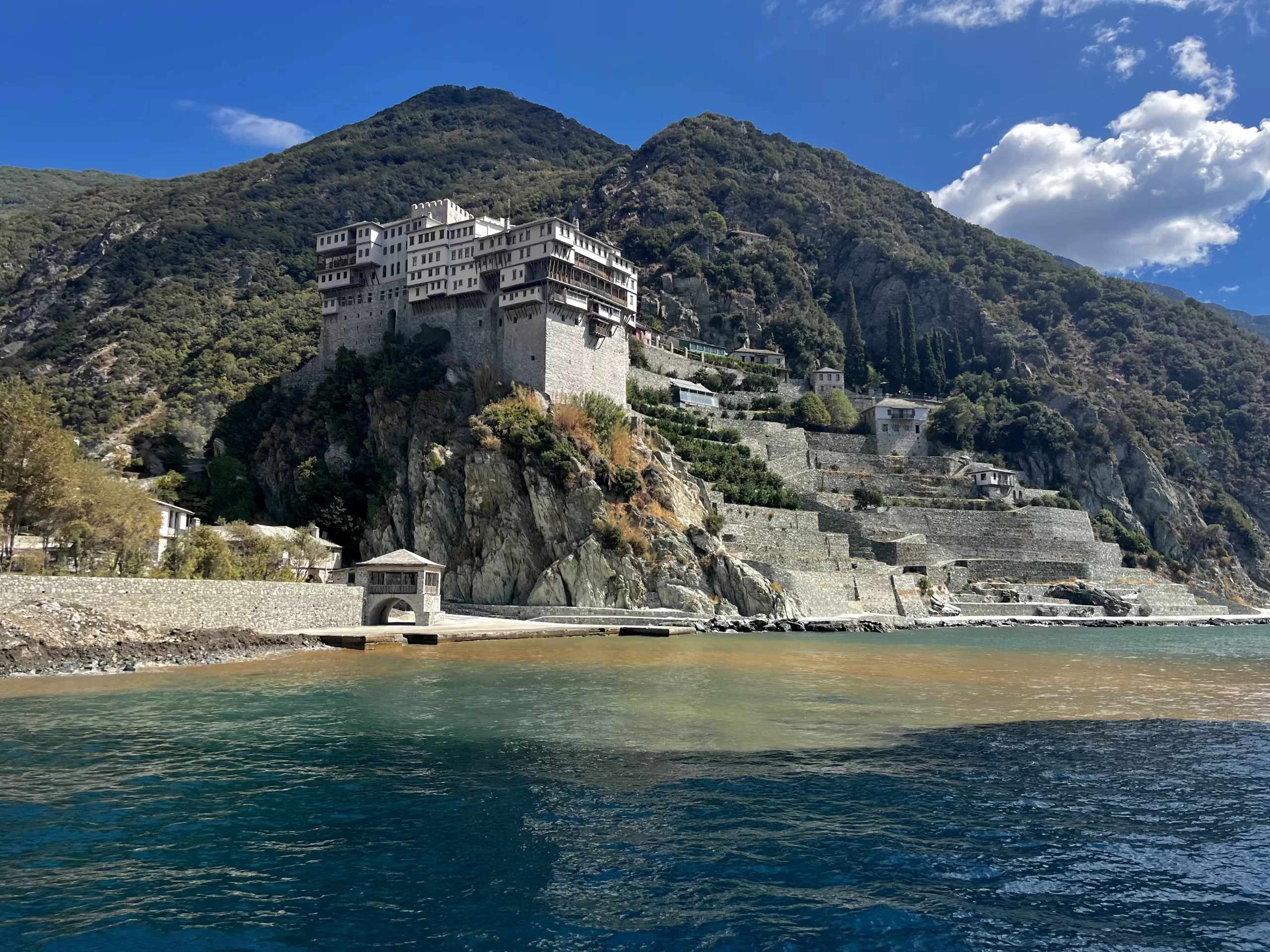
I created my Mount Athos Guide to help you prepare for your journey to Greece’s Holy Mountain. Truly, there is no place in the world quite like Athos – Old Soul Explorer.
Mount Athos is one of the most otherworldly and unusual places in all of Greece. It’s also one of the most unforgettable for those privileged enough to visit. The first time I ever heard of Mount Athos was in a 60 Minutes documentary. From the moment I first learned about this place, I was captivated and knew I had to visit.
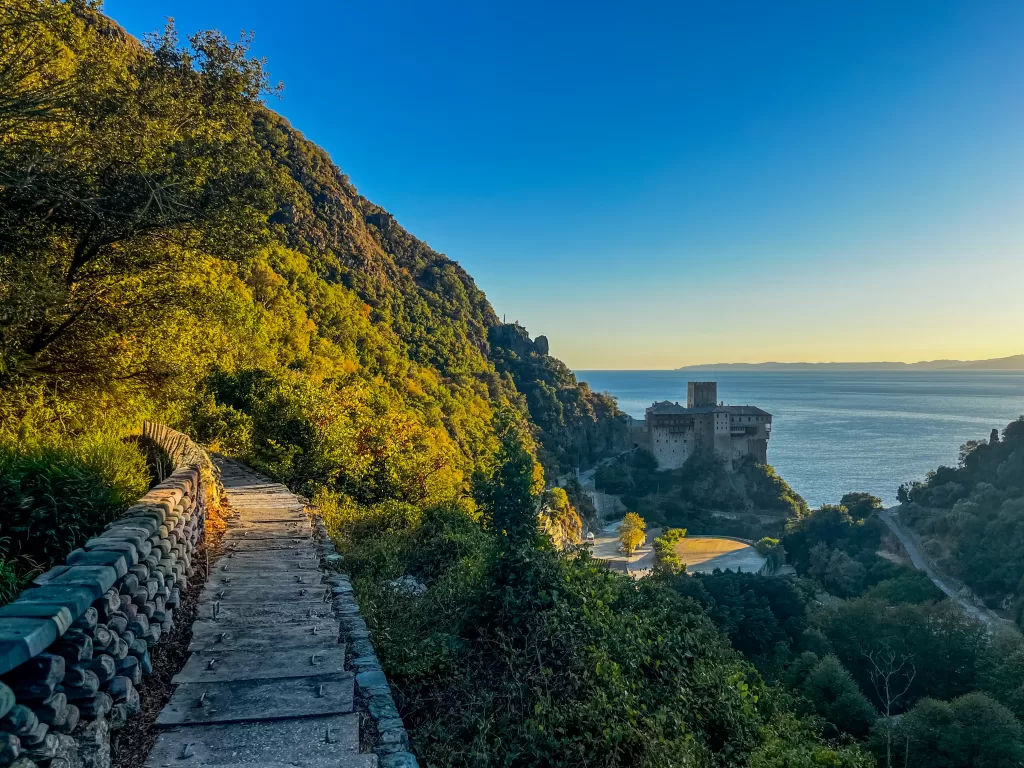
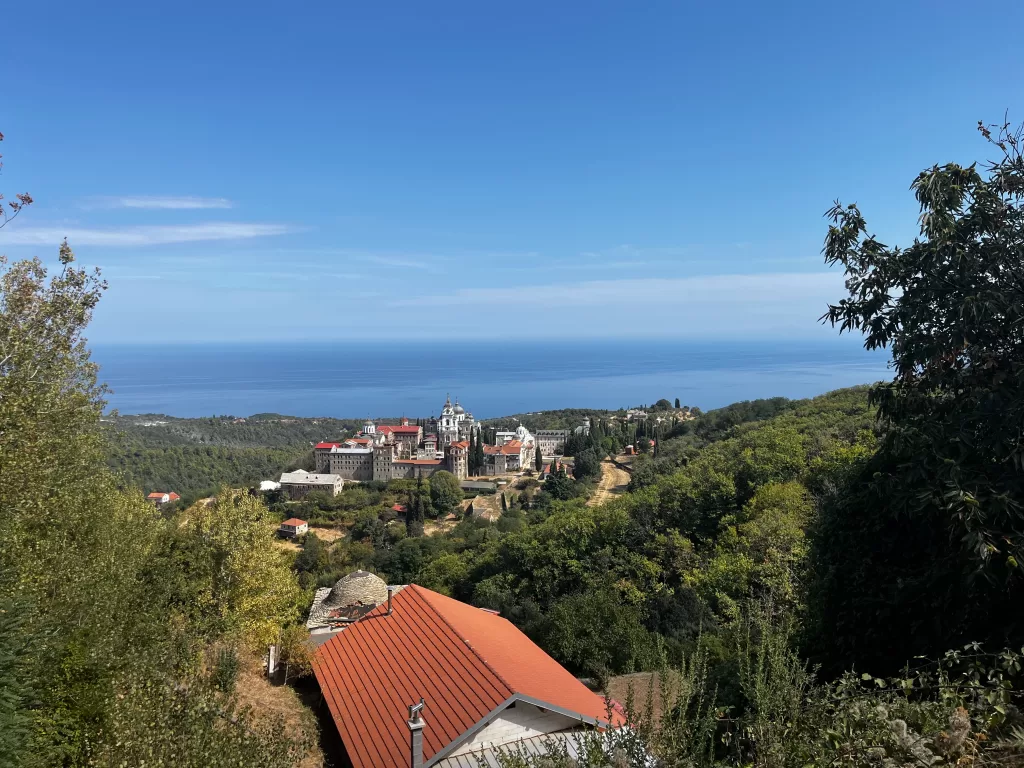
Often referred to as the Agion Oros (Holy Mountain in Greek), visiting Mount Athos feels like stepping into another realm, one seemingly untouched by time. Towering monasteries with high walls and crowned by domes cling to the cliffside or sit on steep hills overlooking the Aegean Sea. They are surrounded by lush forests and breathtaking coastlines, many having their own harbors and ports.
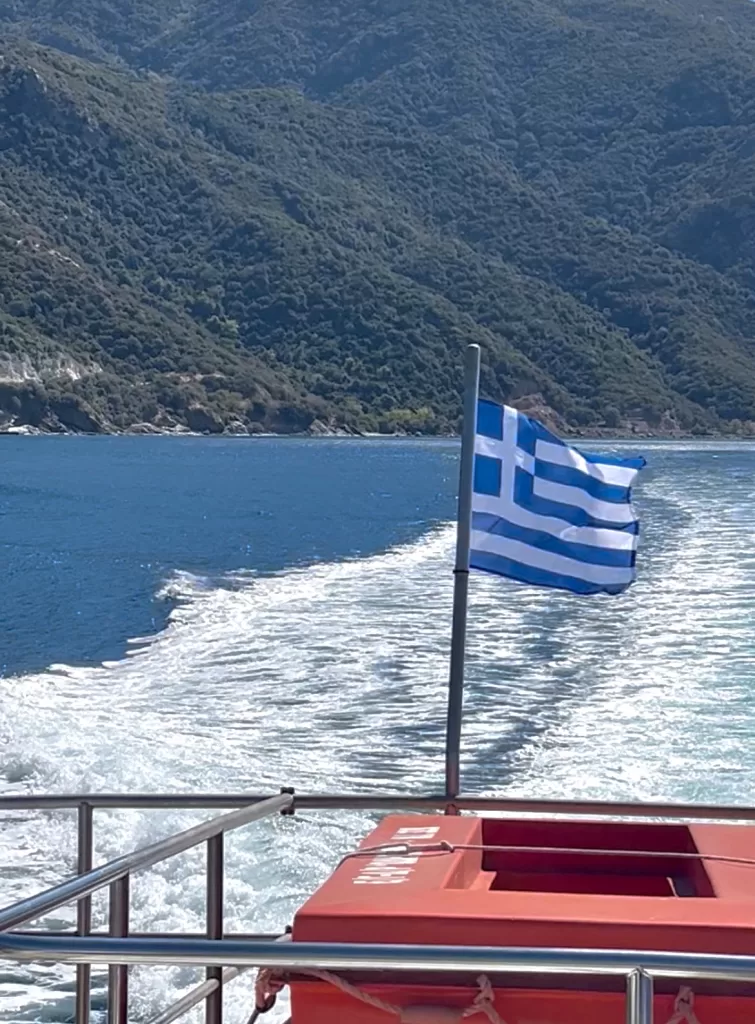
Traveling to Mount Athos isn’t a vacation though, it’s a pilgrimage. It’s a place to seek solitude and contemplation, to reflect and take in everything this place has to offer about this life and beyond. I felt its spiritual energy the moment I stepped off the speedboat that carried us from the mainland to this sacred peninsula set apart from the world.
In my Mount Athos guide, I’ve included everything you need to know about visiting the Holy Mountain. This is a destination that requires careful planning, so I’ve included tips and insights on requesting visitor permits, securing accommodations at the monasteries, transportation, and what a typical day on Mount Athos looks like. I hope you enjoy your time on the Holy Mountain and leave both enlightened and inspired.
What is Mount Athos
Mount Athos is a secluded peninsula in Northern Greece with 20 monasteries where monks live in total devotion to prayer and contemplation. The peninsula is a place of solitude, ritual, and timeless spirituality. It is often considered the beating heart of the Eastern Orthodox religious tradition.
Women are barred from visiting, maintaining the monks’ undisturbed spiritual focus on the monastic way of life and patronage to the Virgin Mary. This restriction, known as the Avaton rule, has been upheld since the establishment of the earliest monasteries on Athos.
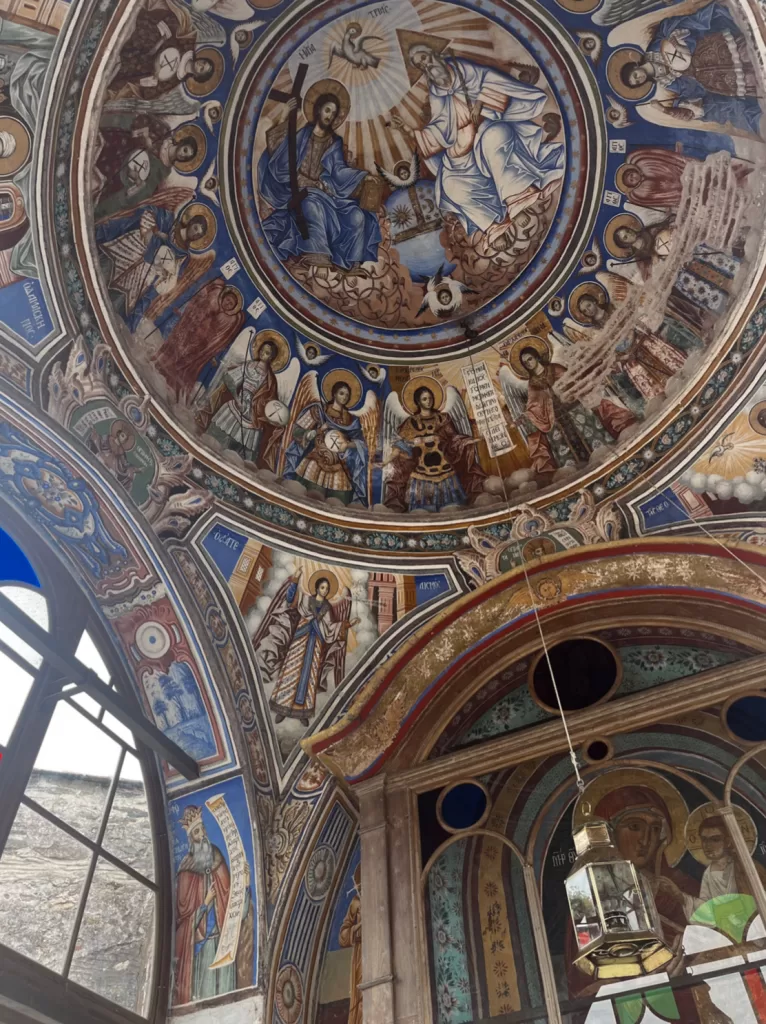
A Brief History of Mount Athos
Mount Athos has served as a spiritual sanctuary for thousands of years. The first monasteries were founded in the 9th century when hermits and monks sought solitude and contemplation among the peninsula’s remote forested cliffs.
The Byzantine Emperor Constantine IX Monomachos formally recognized Mount Athos as an autonomous monastic republic in 1045. More monasteries sprang up, many built with stone walls and towers to protect against invading armies and pirates. The monasteries also became centers of learning and culture, translating the Bible into multiple languages and refining the art of icon painting with delicate gold leaf. Many were economically self sufficient, producing wine, honey, and olive oil for trade with the outside world.
Thanks to the monks’ diplomacy and political skills, the Holy Mountain continued to function normally throughout Ottoman rule which lasted from the 15th-19th centuries. After the Greek War of Independence, the autonomy of Mount Athos was enshrined in the Greek constitution. To this day, life flows as it always has on Athos. Apart from the arrival of electricity and a few buses, very little has changed since the Byzantine era.
My Experience on Mount Athos
Mount Athos is single handedly the most unique place I’ve visited in all of Greece. Time and space are suspended here; the rhythm of life operates independently from the rest of the world. This is Christianity’s Nepal and Tibet, the beating heart of the Eastern Orthodox mystical experience. During my four day stay, I attended the full cycle of religious services, ate with the monks in the refectory (dining hall), and saw spiritual relics and Orthodox icons that were literally thousands of years old.
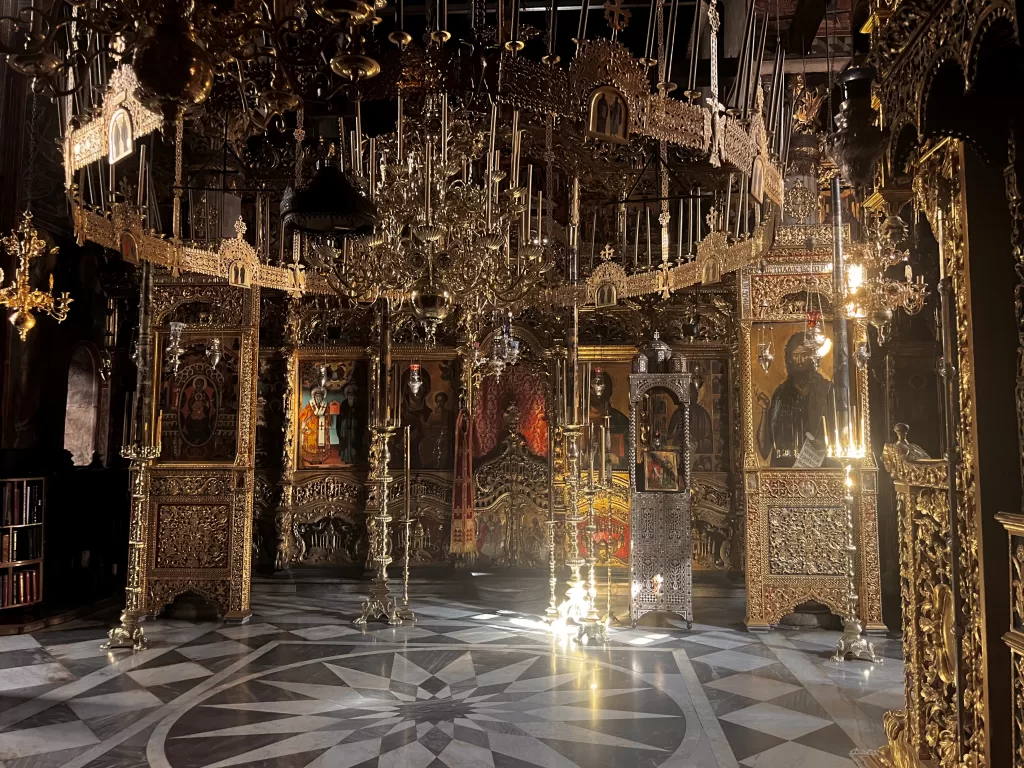
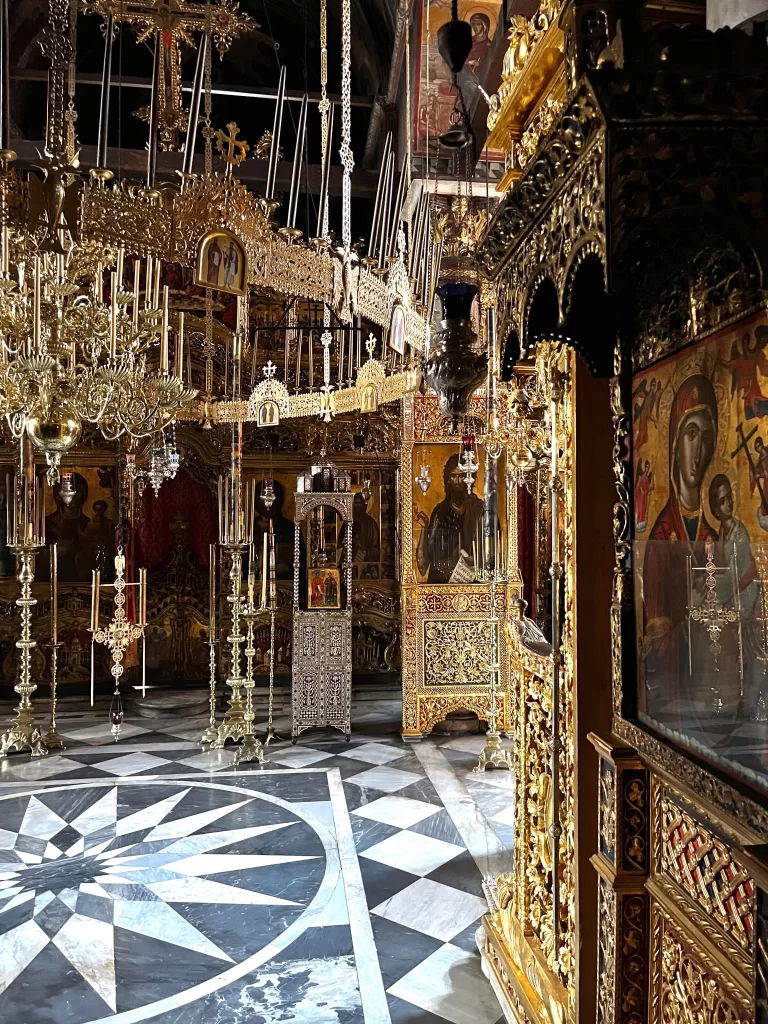
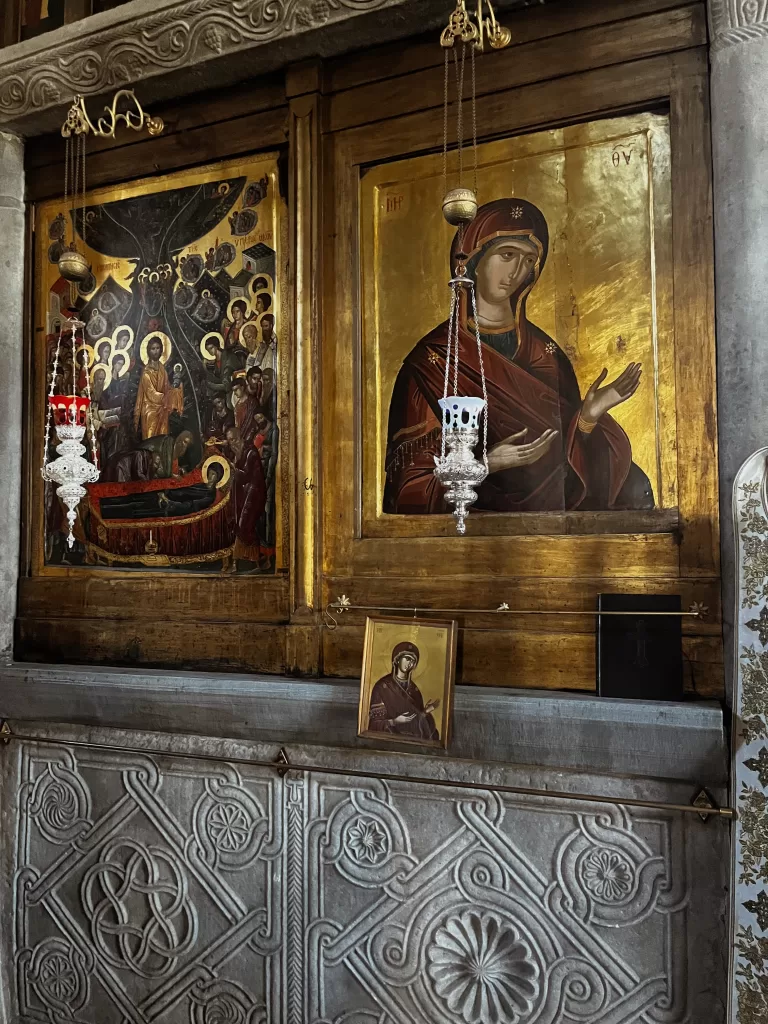
Being a half Greek American traveler, visiting Mount Athos was a rare opportunity to connect with both my religion and culture. Being woken up at 3 a.m. to attend the liturgy in ancient Greek with only a few lit candles preventing me from tripping over thousand year old uneven marble floors felt like a once in a lifetime experience. In the middle of the night, the hanging oil lamps illuminating the icons of the Virgin Mary and the saints looked like twinkling stars in the otherwise pitch black church. I didn’t mind that I didn’t know the language, I felt everything that was happening: the chanting, the incense, and the gaze of the icons that pierce right through you. This place is one of Greece’s greatest treasures.
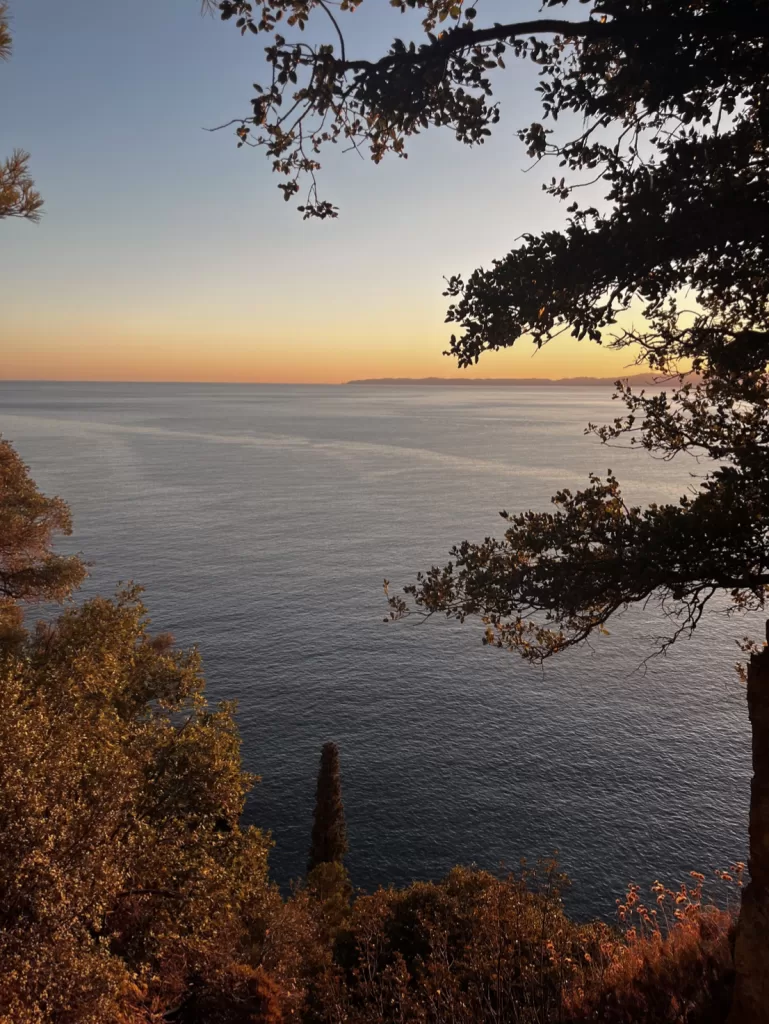
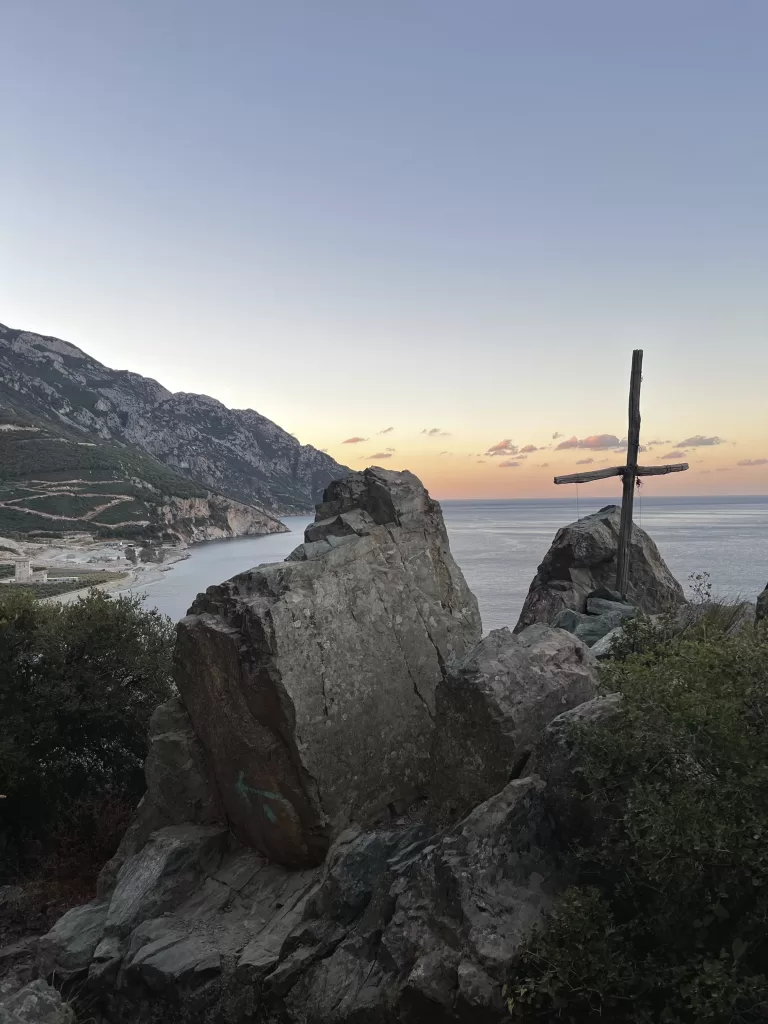
For me, hiking the wooded trails around the monasteries that overlook the Aegean Sea was a profoundly reflective and contemplative experience. Many of the trails are built on the balconies of mountains that offer panoramic views of the ocean and are surrounded by dense forests of olive, cypress, and pine trees. The nature here is truly some of the most scenic and protected in all of Greece. Towering above it all is the peak of Mount Athos, casting an even deeper air of mystery over the terrain.
A Holy Place With Complicated Realities
And while I had a profoundly impactful experience on Mount Athos, I also felt conflicted about being there at times. It didn’t hit me how I would feel about women being prohibited from visiting Athos until I got there. I never understood why women were banned from visiting, which has been enforced since the Holy Mountains earliest foundations. It was hard to wrap my head around why the miraculous belt of the Virgin Mary, known for curing infertility and protecting women during childbirth, was kept on a peninsula where only men can access.
I struggled with the fact that I was surrounded by so many Russian pilgrims who while kind and devout, were allowed to visit Mount Athos during a war of aggression between two Orthodox countries. Russian Orthodox Patriarch Kirill called the invasion a “holy war”. The response of the Holy Mountain has been one of silence if not aloofness toward the situation. These things were not lost upon me during my time at one of the holiest places in Orthodoxy.
But I remained silent. I was visiting Mount Athos as a guest, as a traveler. My task was simply to absorb as much as I could. Sometimes, having a nuanced experience is what makes travel so impactful to begin with.
My Mount Athos Guide – All You Need to Know About Greece’s Holy Mountain
Experience the serene beauty and profound spirituality of Mount Athos, one of the most sacred places in the Orthodox world. From its monasteries perched on cliffs and idyllic landscapes, discover why this remote monastic peninsula is unlike anywhere else in Greece.
Mount Athos Guide Essentials
- Country: Greece
- Region: Central Macedonia, Chalkidiki Peninsula
- Language: Greek; some English spoken by guides and monks
- Currency: Euro (bring cash!)
- Emergency Information: 112 (general emergencies)
- Climate: Mediterranean, hot dry summers, mild wet winters
- Best time to visit: May-June, September-October
- Dress Code: Pants (not shorts), closed toed shoes, long sleeves (preferred)
Best Time to Visit mount Athos
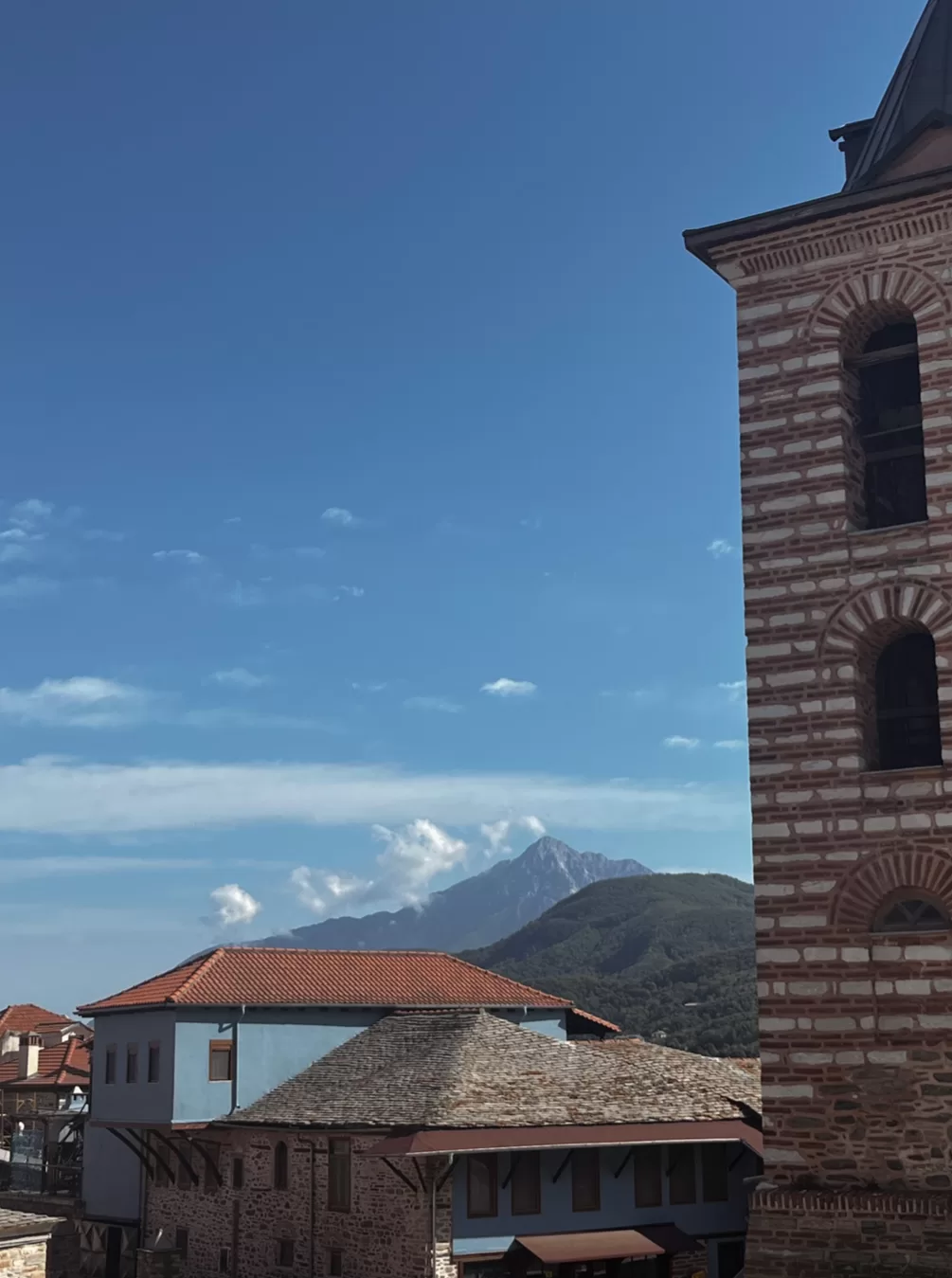
Mount Athos gets busiest during the summer months of July-August. Many Greeks and pilgrims from Eastern Europe are on summer break during this time. Monasteries overflow with visitors and hiking between them can be uncomfortable due to the heat. The Holy Mountain is also especially crowded during major feast days such as Pascha (Easter) and the Assumption of the Virgin Mary on August 15.
I visited towards the end of September and the weather was perfect. It was warm and pleasant during the day and cooler in the evening. Additionally, the rainy season hadn’t fully arrived yet so the days wer’e sunnier. May to early June is another ideal time to explore the Holy Mountain before the crowds and heat arrive.
Who Can Visit Mount Athos
Only men are allowed to visit Mount Athos. This is due to the “Avaton” rule which was set in place during the Byzantine Empire. The tradition was established to preserve the monks celibate way of life and their spiritual focus on the Virgin Mary, who according to tradition, was the last woman to set foot on the Holy Mountain. Even female animals are barred from Athos.
Pilgrims to Mount Athos must be over 18 years old. Orthodox and non Orthodox can visit, but priority is given to Orthodox Christians.
How Can Women experience Mount Athos
I personally do not understand why women are not allowed to visit Mount Athos. This rule will most likely never change. However, women pilgrims can sometimes take a cruise around the Holy Mountain. The boat is required to stay 2,000 feet away from the peninsula at all times. The cruise usually offers views of seaside monasteries like Xenophontos, Simonopetra, and Dionysiou and holy relics and icons are often brought aboard for blessings.
// Book seats for the women’s pilgrim cruise of Mount Athos here.
Diamonitirion | Entry Visa for Mount Athos
Mount Athos is a semi autonomous monastic republic. While under Greek sovereignty, Mount Athos is exempt from certain civil laws that allow it the freedom to manage its own affairs. The Greek Constitution (Article 105, Section 2) explicitly recognizes the autonomy of Mount Athos. International law and the European Union also acknowledge the self governance of the Holy Mountain.
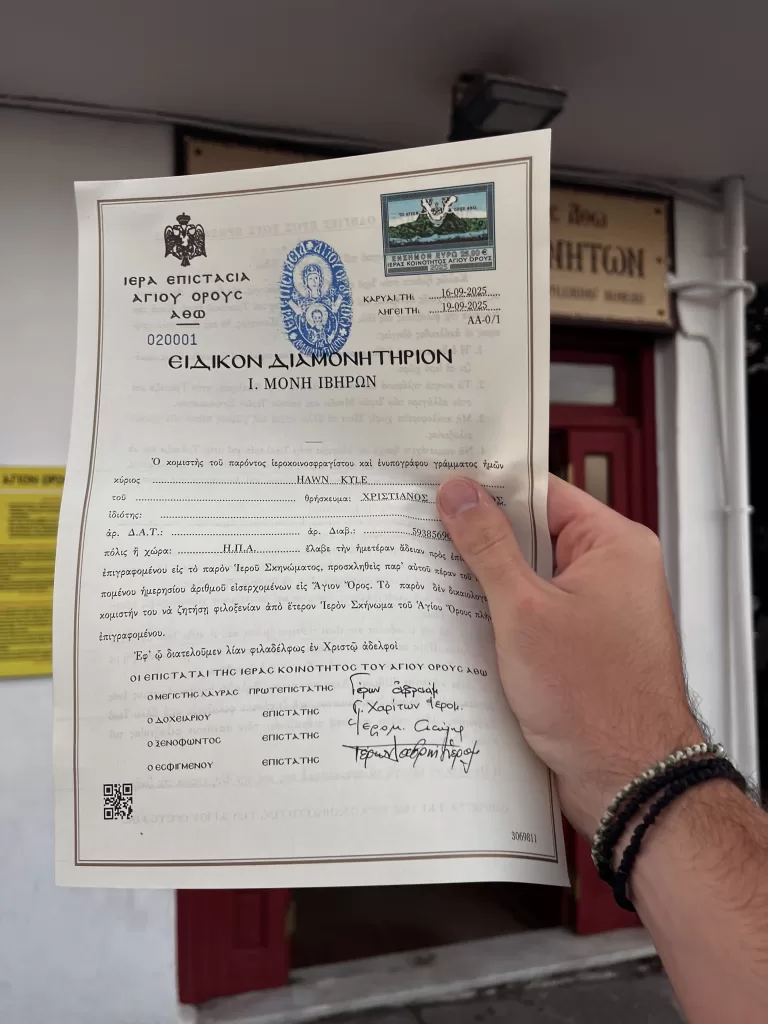
Because of this, Mount Athos has the authority to allow or deny entry to visitors at their discretion (hence no women allowed). The Diamonitirion is the special entrance permit needed for anyone who wants to steep foot on Athos. The document serves as a visa and is issued by the Pilgrims’ Bureau of the Holy Mountain, typically granting permission to visit for 4 days and 3 nights. If you would like to stay longer, you will need special permission from the Pilgrims Bureau with your reason for an extended stay. The entry permit must be acquired by all visitors, even clergy. You will need to keep this document with you throughout your stay on the Agion Oros. Many of the monasteries ask to see it upon arrival before showing you to your room.
You can apply for the Diamonitirion up to six months in advance. Applications are on a first come first serve basis. There are 100 permits for Orthodox and 10 for non Orthodox issued per day. I recommend requesting your Diamonitirion as early as you can, especially if you plan to visit Mount Athos during the summer months. The Diamonitirion costs between € 30-35.
I’ve included the location of the Pilgrims Bureau in my Google Maps attached to this blog. This is where you will pick up the Diamonitirion permit before embarking on your journey to Athos.
// Here is the contact information for acquiring the Diamonitirion. You can pick up the document in either Thessaloniki or Ouranoupoli.
Thessaloniki Pilgrims Bureau (Agioritiki Estia)
- Address: 109 Egnatia Street, 54622 Thessaloniki, Greece
- Phone: +30 2310 252578
- Email: athosreservation@gmail.com
Ouranoupoli Pilgrims Bureau
- Address: 63075 Ouranoupoli, Greece
- Phone: +30 23770 71421
- Email: officepilgrims@gmail.com
Getting To Mount Athos
It’s quite the journey just to get to Mount Athos. First, you’ll need to fly to Thessaloniki, Greece’s second largest city. From there, you’ll have to get to the KTEL Chalkidikis Bus Station. The bus station is a good distance from the historical city center.
It’s approximately a 3 hour bus ride from Thessaloniki to Ouranoupoli, the port city that serves as the launching pad for trips to Mount Athos. Along the way, the bus stops at small chorios (villages) and even on the side of the road to pick up passengers. Some of the bus stops are at the most random locations. Ouranoupoli is the very last stop.
Tickets usually cost less than €15 which I found a great value for the experience overall. The bus to Ouranoupoli felt clean and the seats were spacious. I definitely recommend purchasing your tickets in advance to secure your transportation to Athos and reserve a better seat.
Get to the bus station early. Announcements are only in Greek and the lines are not well organized. I made sure to ask the staff behind the glass counters inside the bus station where I was supposed to wait. I didn’t want to miss my ride.
// Here you can reserve your KTEL Chalkidikis Bus ticket and seat for getting to Ouranoupoli.
Note: due to a translation error KTEL, names Ouranoupoli as“Oyranoypoli”. You will need to look up the destination location under this name. The website has the full list of bus trips and times. I booked seat 4 at the front of the bus by the window. It was a good way to soak in the small villages and the countryside of Greece’s Chalkidiki region.
The alternative to taking the KTEL bus is to hire a private taxi or rent a car and drive to Ouranoupoli, both of which would be much more expensive.
Ouranoupoli | Gateway to Mount Athos
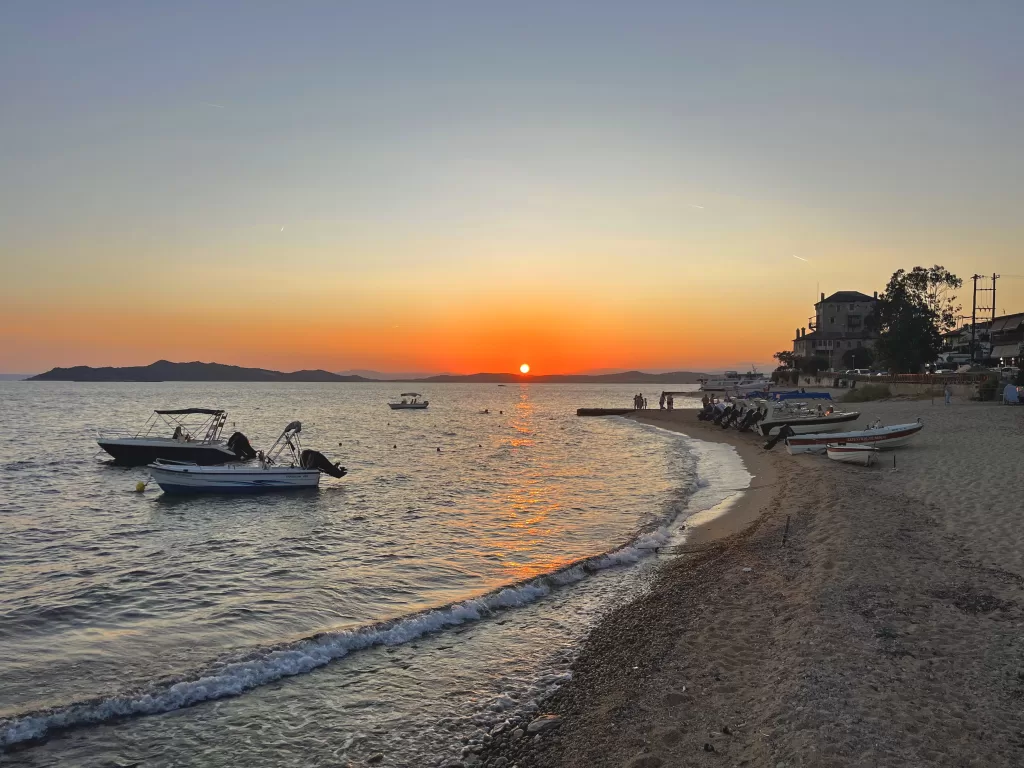
The small port town of Ouranoupoli serves both as a cheap summer vacation hotspot and the departure point for pilgrims to Mount Athos. You’ll see a mix of families going to the beach, pilgrims with hiking gear, and monks in flowing cassocks. There are several tavernas and cafes by the waterfront along with overpriced jewelry and icon shops.
I’d recommend staying the night in Ouranoupoli that way you can catch the earliest ferry to Athos the following morning. I stayed at the Arxontariki Suites, a cozy guesthouse in the center of town which had all the amenities you need as a traveler. It’s also close to the Byzantine Tower, the perfect place to walk on the beach and watch the sunset.
It’s also possible to take the 6:00 a.m. bus from Thessaloniki and ferry to Mount Athos on the same day. Most pilgrims need to pick up their Diamonitirion from the Pilgrims’ Bureau in Ouranoupoli which is close to the port.
Ferries to Mount Athos
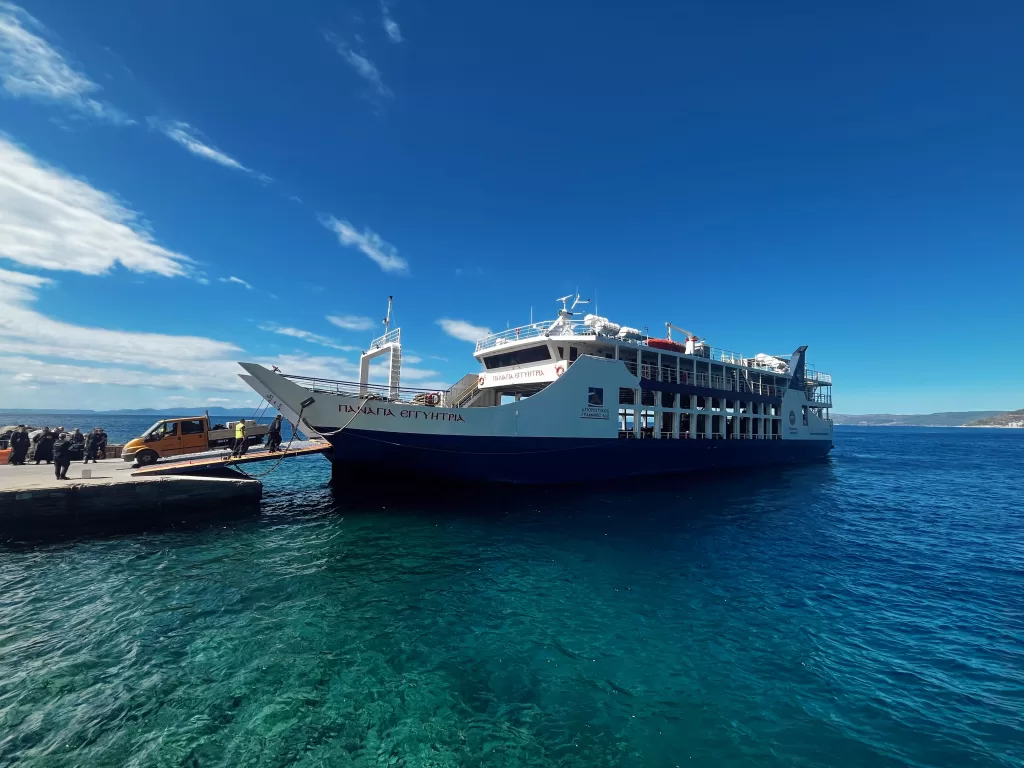
The two most common ferries that bring pilgrims from Ouranoupoli to Daphni, Mount Athos main port, are Agia Anna and Odigitria. Both usually have two round trips per day. It’s around an hour trip to reach Mount Athos from Ouranoupoli. The boat ride is filled with stunning views of the peninsula’s walled monasteries that sit on the coastline or perched on cliffside rocks. Rising above it all is the towering summit of Athos itself.
Agia Anna Ferry
- No ticket required in advance
- Approximately €15
- 1 hour trip
- Phone: +30 6947 819 885
Odigitria Speedboat:
- Ticket required in advance (10 days recommended)
- Approximately €15
- 1 hour trip
- Phone: +30 23770 71149 or +30 23770 21041
// More information on Ferries to Mount Athos and daily times.
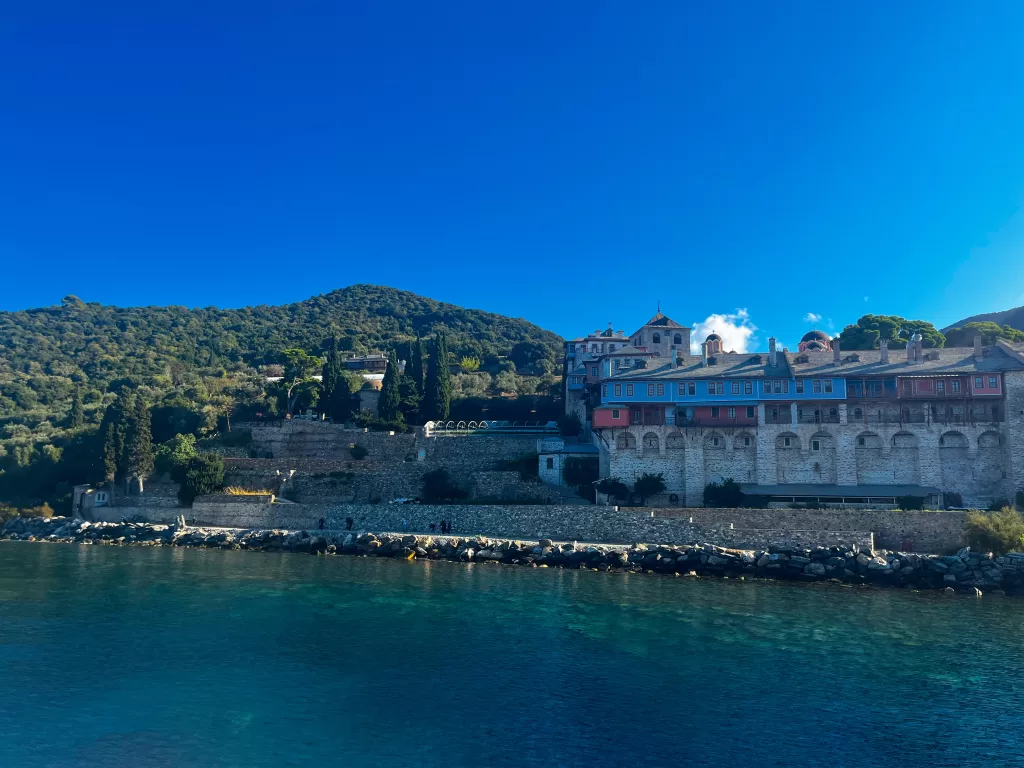
Transportation on Mount Athos
Transportation options are limited on Mount Athos. Here is everything you need to know about moving around the Agion Oros.
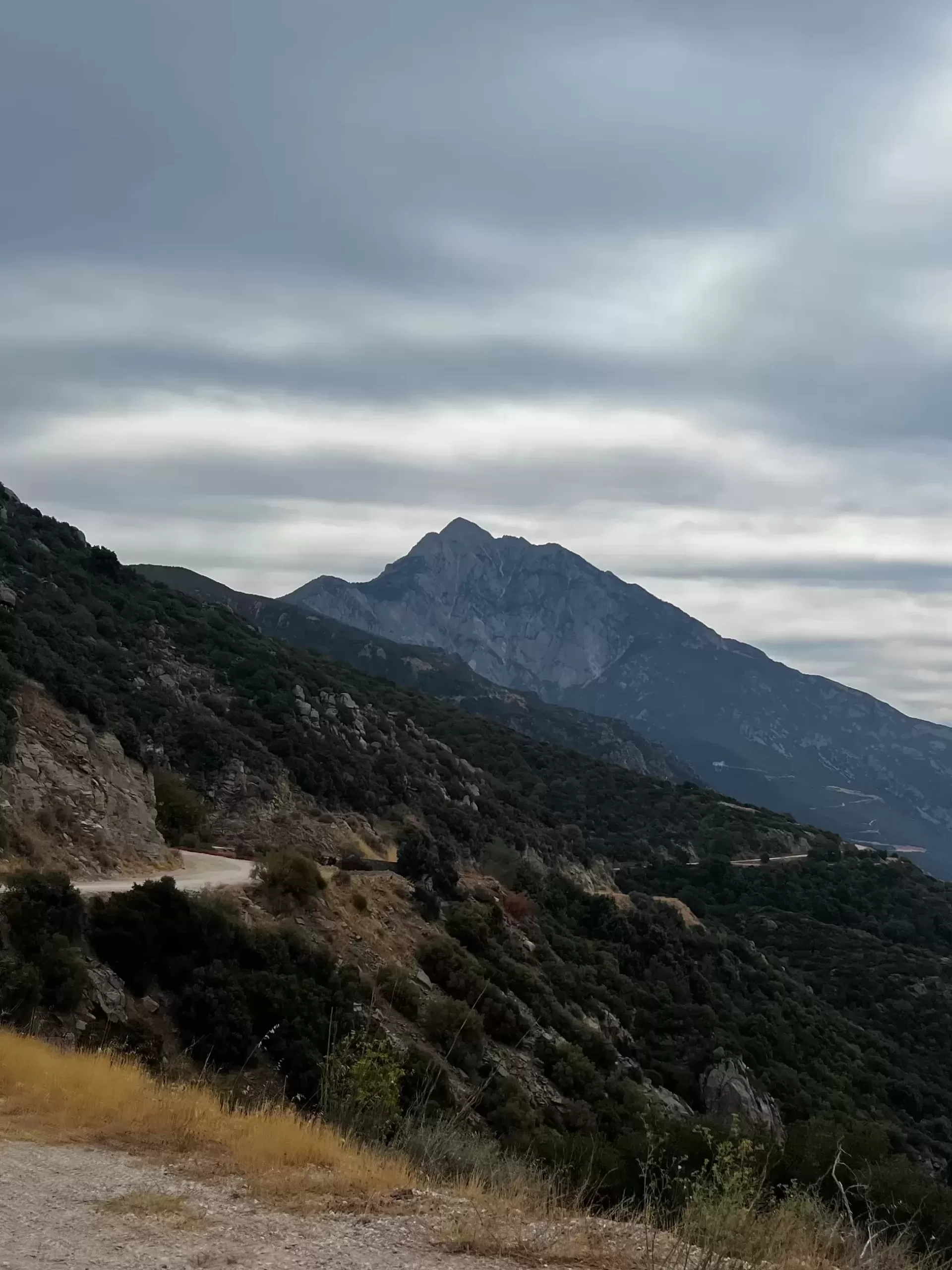
The majority of roads on Mount Athos are gravel and unpaved. This makes the process of getting around the interior of Athos very slow, even between close monasteries. Sections of the road can be narrow and bumpy. Pilgrims are not permitted to drive on Mount Athos.
Buses | Karyes Center
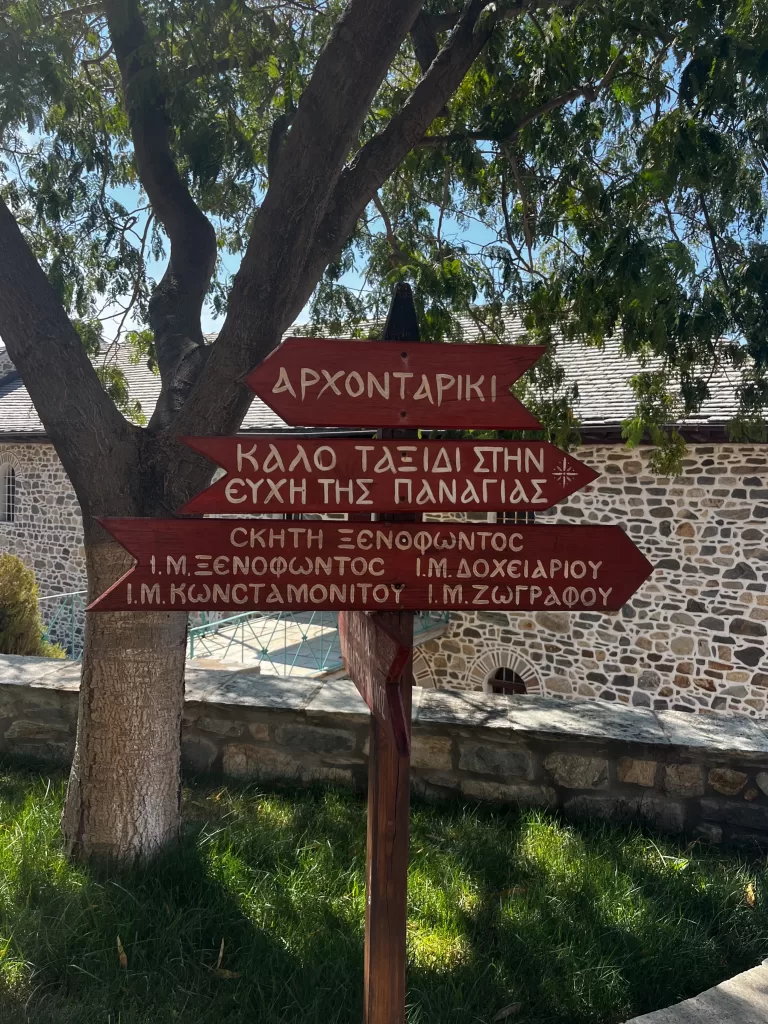
One of the easiest and most affordable ways to get around Mount Athos is by bus. Large buses transport pilgrims between the monasteries several times a day. The buses are old but well maintained.
On the bus, you’ll notice a sea of flowing robes, long beards, and black hats called Kalymavkion (usually worn by Orthodox clergy). The bus is usually silent but sometimes a liturgy or religious chant in Greek plays softly through the speakers.
Most buses will pick pilgrims up from the port of Daphni and bring them to the capital of Karyes. There are multiple daily buses connecting Daphni to Karyes every day when the speedboats and ferries arrive.
In Karyes, you’ll find a line of different buses waiting to transport pilgrims to the various monasteries. You’ll need to know when your bus is departing, but reservations aren’t required. Fares typically range from €3 to €5. Larger monasteries have more structured bus schedules, while the others have several trips a day but are less predictable.
My best advice is to arrive in Karyes early and check when the bus for your monastery departs. Things on Mount Athos aren’t always clearly marked or perfectly organized, but if you ask for help someone will always point you in the right direction.
//Here is more information on the bus schedules on Mount Athos
private Taxis and Minibuses
It’s possible to arrange private transportation outside the regular bus schedules to get around Mount Athos. A range of small minibuses, vans, and jeeps connect pilgrims to the surrounding monasteries. Some are driven by the monks themselves.
Depending on the destination, prices can range from €25 to €100. Cost is most often split between the passengers of larger pilgrim groups. To book private transportation, you’ll need to either contact your monastery or coordinate with a travel agent on Mount Athos.
Water Taxis
Private water taxis offer flexible transportation between monasteries on Mount Athos’ coastline and the port of Ouranoupoli. They’re ideal for small pilgrim groups who need to travel directly to a specific monastery by sea.
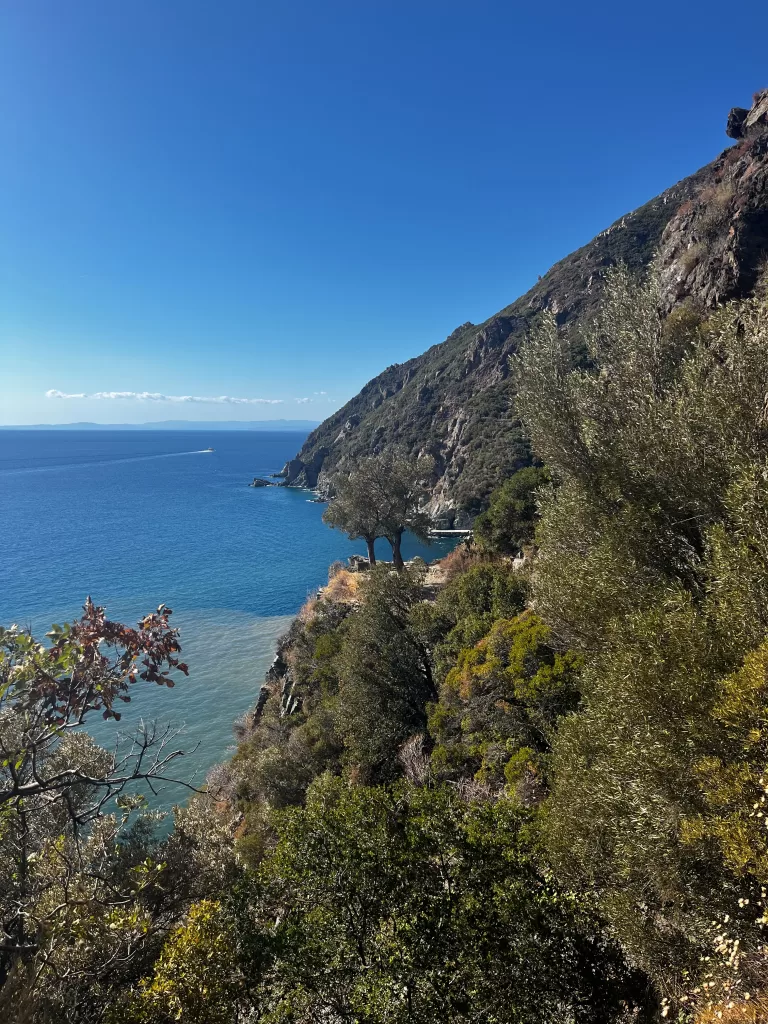
Hiking Between the Monasteries
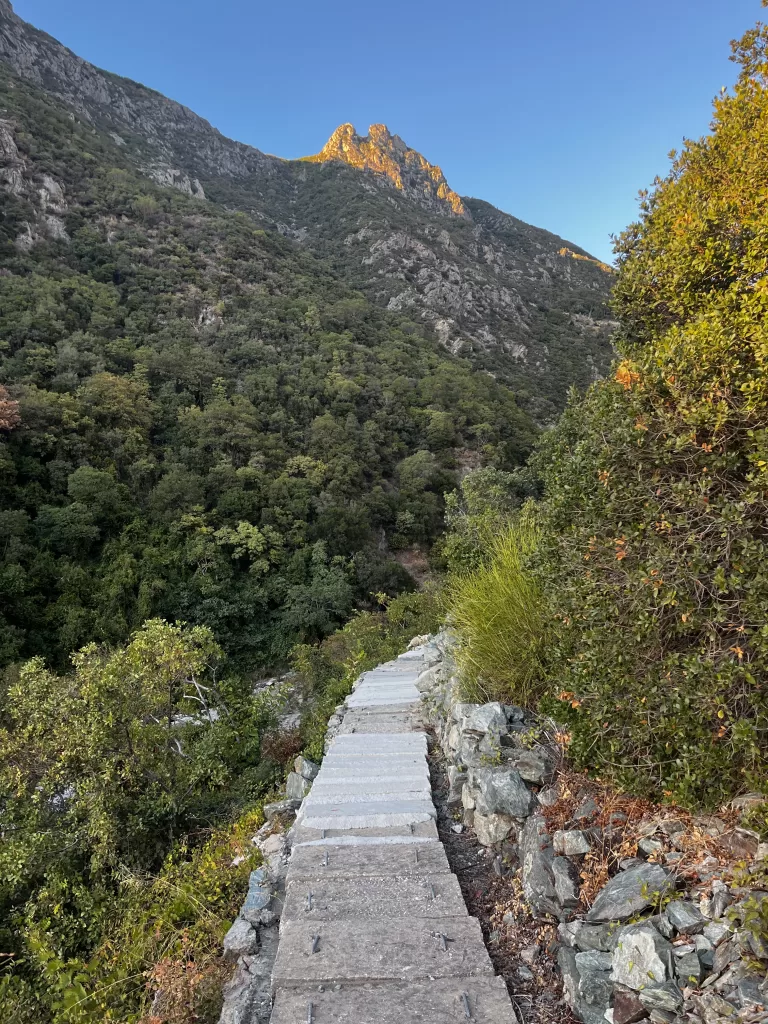
Hiking between the monasteries on Mount Athos is a beautiful way to experience the peninsula’s quiet forests and timeless scenery. Ancient footpaths once used by monks still connect many of the monasteries, though the trails can be steep and rugged in places. If you choose to walk, bring good shoes, plenty of water, and patience. On Athos, the journey itself is part of the pilgrimage. I think hiking is the most immersive way to move around the Holy Mountain.
Requesting Accommodations on Mount Athos
To stay overnight at the monasteries on Mount Athos, you’ll need to request accommodation in advance by phone, WhatsApp, or email. You simply call or write to the monasteries you wish to visit and request a place to stay. Lodging at the monasteries is free. Don’t expect resort level amenities though, lodging on Athos is “no frills” in the truest sense. Additionally, the majority of the monasteries don’t have wifi.
There are two main types of sleeping arrangements on Athos; dormitory and cell style rooms. Dorms are large open spaces that fit multiple twin beds and are ideal for pilgrim groups. However, if you’re traveling solo like I was, there’s a chance you’ll be rooming with people from other countries who don’t speak your language.
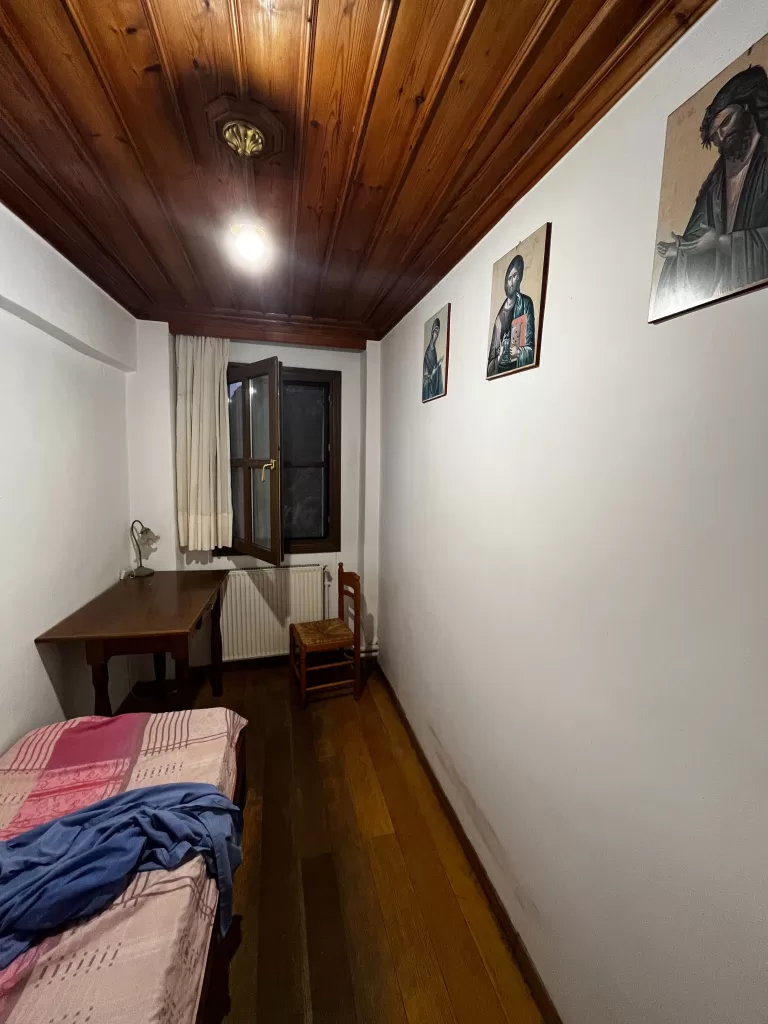
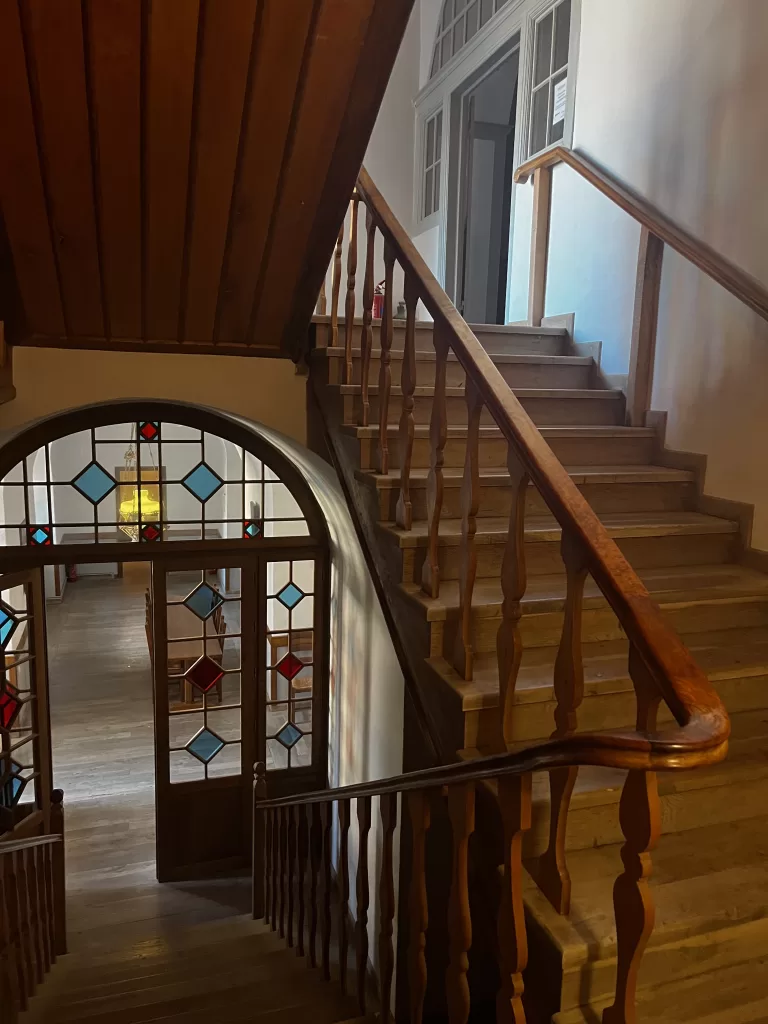
The larger monasteries often have numerous cells, or individual sleeping quarters. Cells are narrow individual rooms that come with a twin size bed, blanket, pillow, and towel. The cell I stayed in at Dionysiou Monastery had an incredible view of the Aegean Sea. Some monasteries have more cells than others, so it’s worth asking about room types before you make your reservation.
It’s best to request accommodation at least one month in advance. During summer (June-September) or around major Orthodox feast days contact the monasteries two months in advance. You will be required to show your Diamonitirion permit upon arrival before being shown to your room.
// Here is the full contact list for all the monasteries on Mount Athos to request accommodations
A Typical Day on Mount Athos
Life on Mount Athos is structured around religious services, meals, and the daily rhythm of the monasteries, with the gates bolted shut at sunset until the following sunrise.
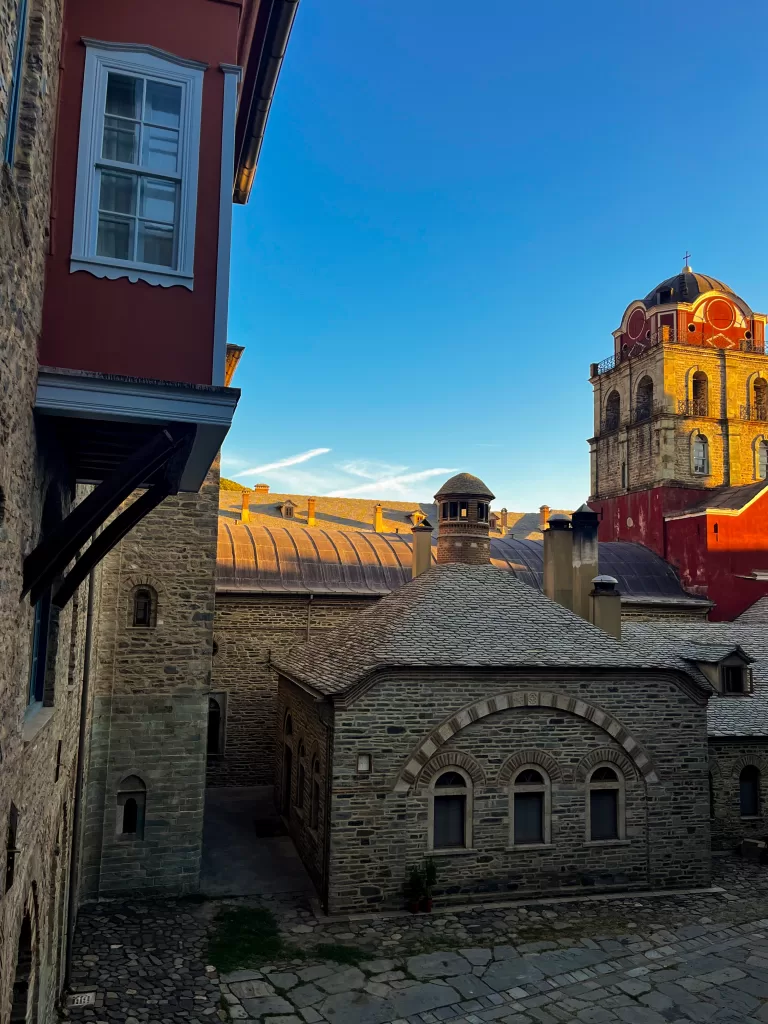
Services on Mount Athos
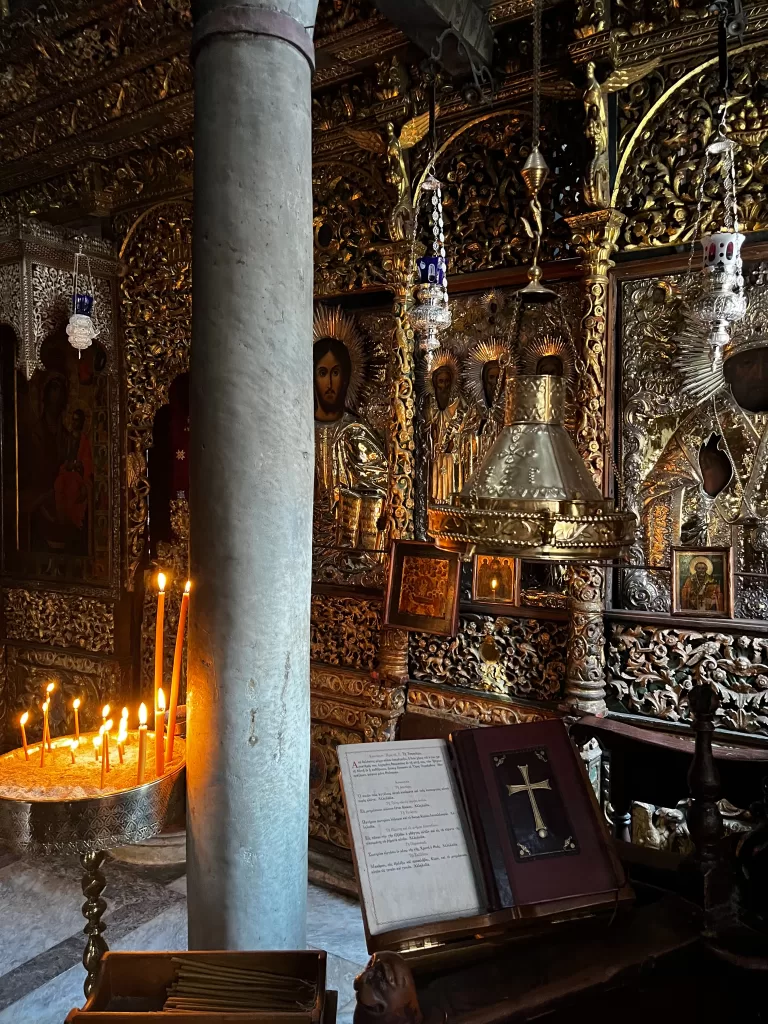
The day often begins around 3:00 a.m with the Orthros and the Divine Liturgy, or morning church services. A monk will walk around striking a wooden or metal semántron, a plank instrument used to wake the monastery and call everyone to prayer. The Divine Liturgy usually ends around 7:00 a.m.
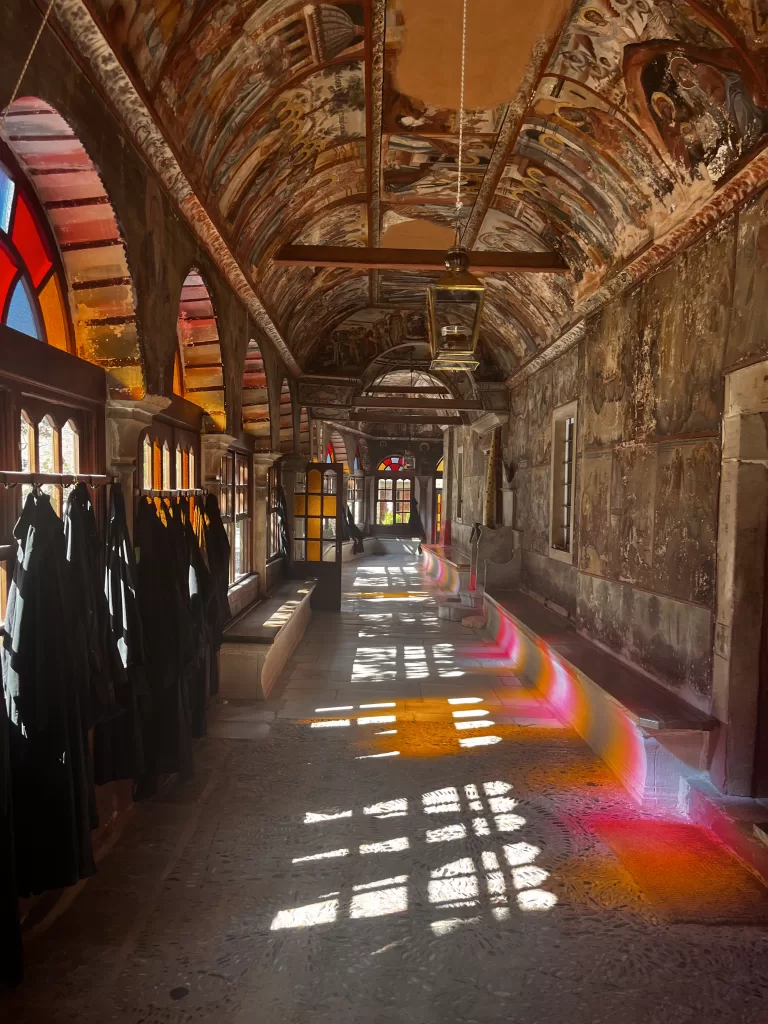
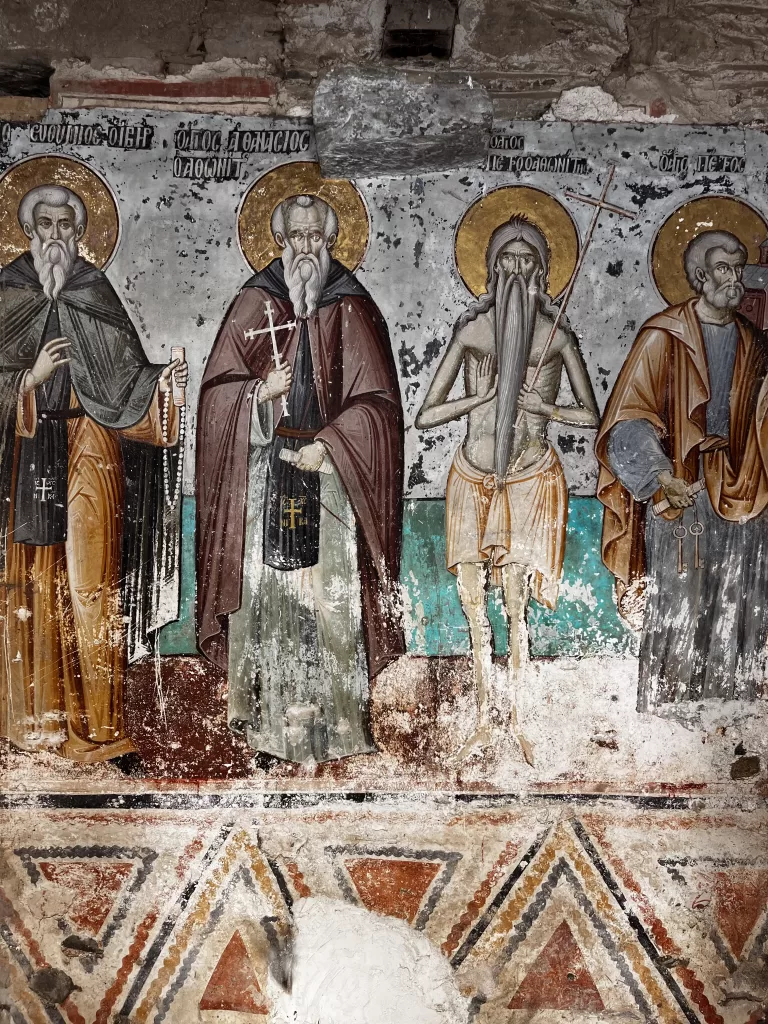
Guests are not required but highly encouraged to attend the religious services. I usually woke up around 4:30 or 5:00 a.m. and the services were already well underway. Experiencing these rituals is deeply mystical and surreal. You are immersed in a spiritual landscape of dramatic frescoes, glistening icons, and hanging oil lamps. One monk originally from America explained that the design of Mount Athos churches is intended to bring a piece of heaven down to earth.
The services are entirely in Greek (or other languages if you visit one of the Slavic monasteries). A monk usually reads from the Bible or chants in a soft voice. One phrase you will hear repeatedly is Kyrie Eleison or lord have mercy, a prayerful plea that is one of the most memorable sounds of Mount Athos.
Meals in the Refectory
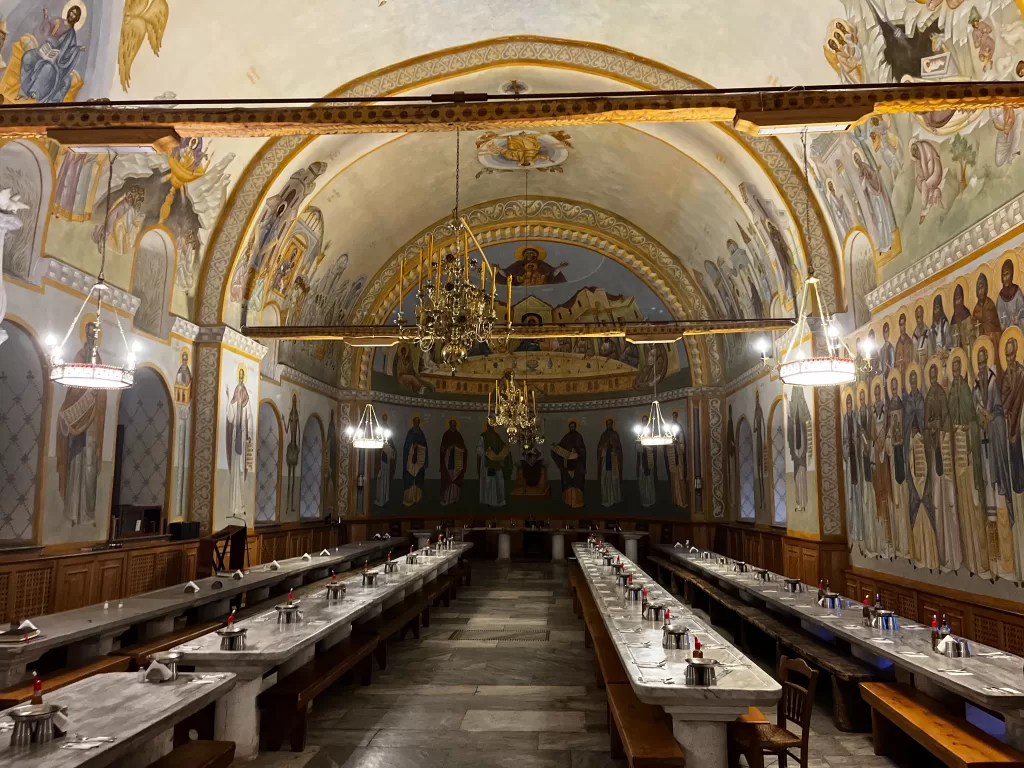
There are usually only two meals on Mount Athos. Pilgrims eat with monks in the refectory, or communal dining hall. The main meal is dinner after the evening church services. Everyone is seated at long tables where the food is set out. A monk reads the Bible in ancient Greek and no one talks. Everyone eats quickly and silently. When the reading is done, a bell is rung and everyone stops eating and exits the refectory.
There is a lighter morning meal usually consisting of olive oil and whole grain bread. The food on Mount Athos is simple yet incredibly nourishing. The simple and smaller portions are intended to sustain the body without distracting from prayer and contemplation, emphasizing balance and mindfulness.
Arrival at New monasteries
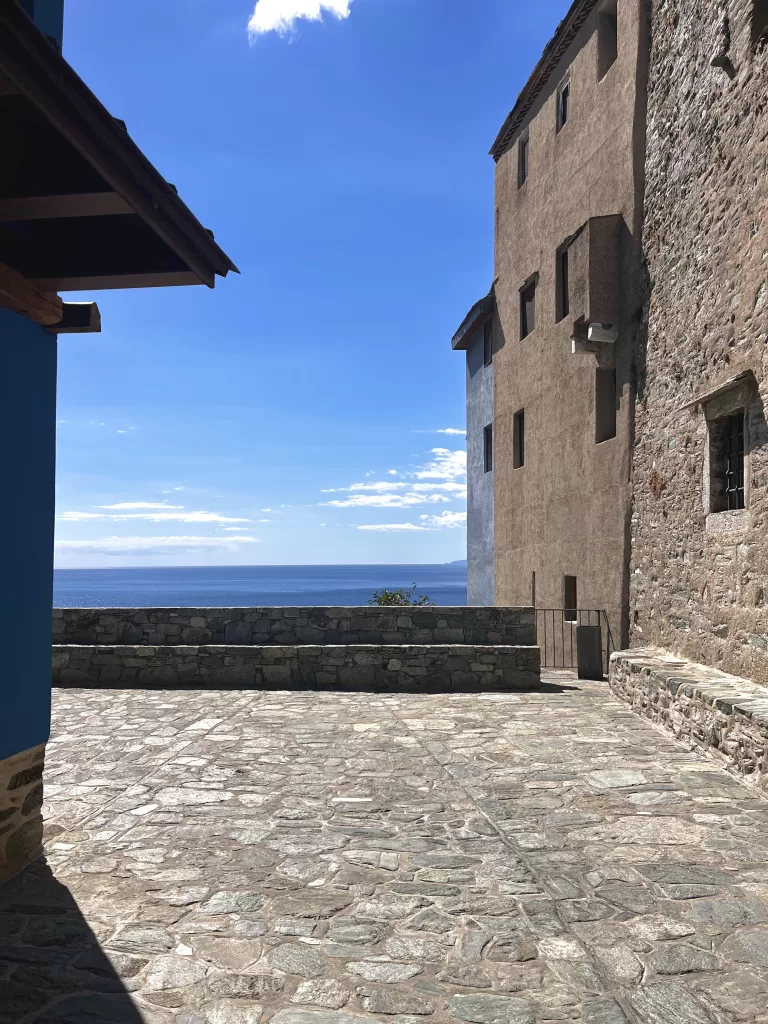
After the Divine Liturgy and morning meal, many pilgrims collect their belongings and depart the monastery they were staying at. The remainder of the day usually consists of traveling to the next monastery either by vehicle, boat, or hiking.
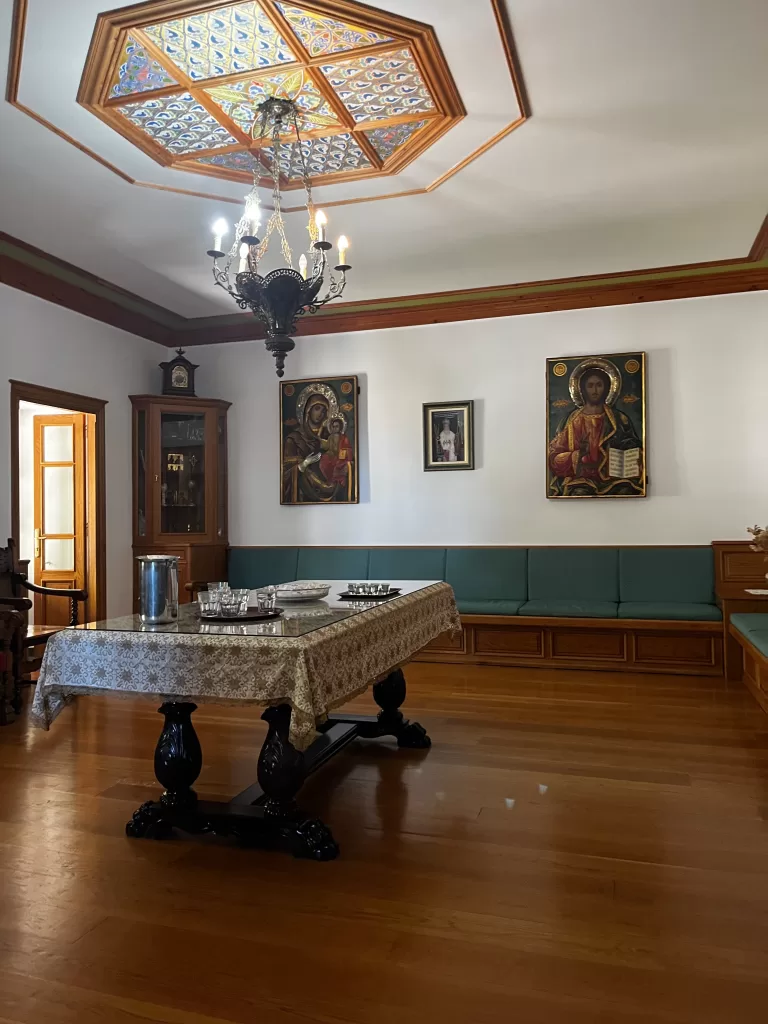
Upon arriving at a monastery on Mount Athos, a tray of pastries and Greek Coffee or traditional liquor called tsipouro, similar to the Italian grappa, is set out as a greeting. Pilgrims can enjoy the monasteries’ serene surroundings, walk the mountain trails, or speak with the monks about spiritual life.
Other things You Should Know Before Visiting athos
Here are a few other helpful tips you should consider before planning your journey to the Mount Athos.
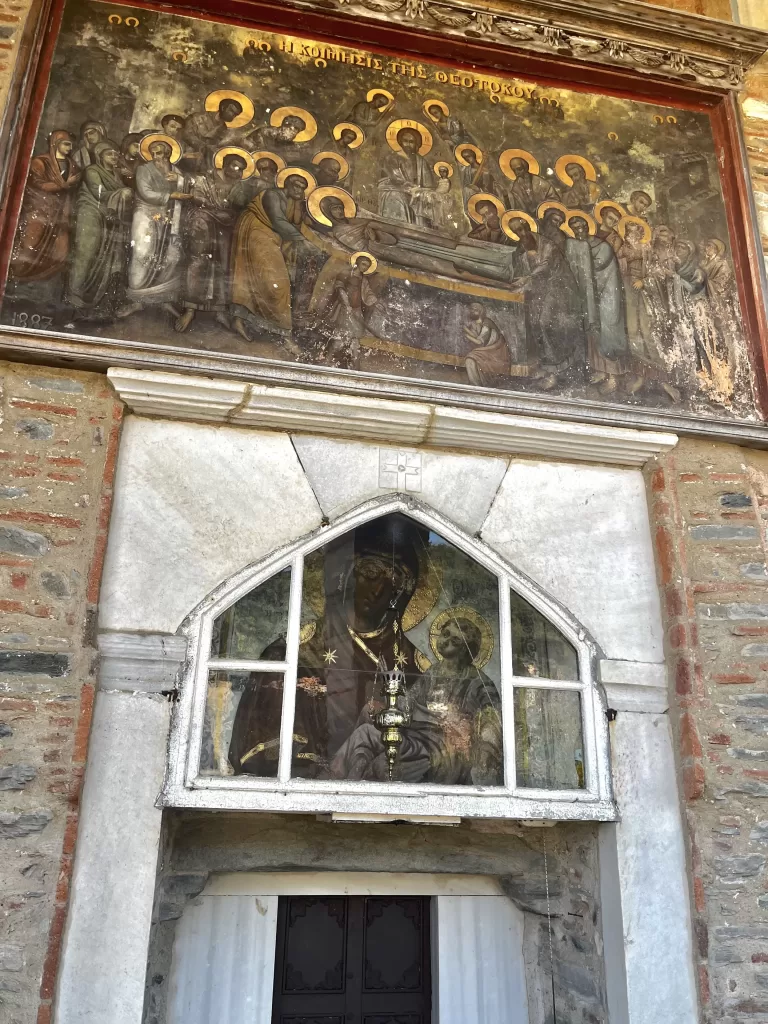
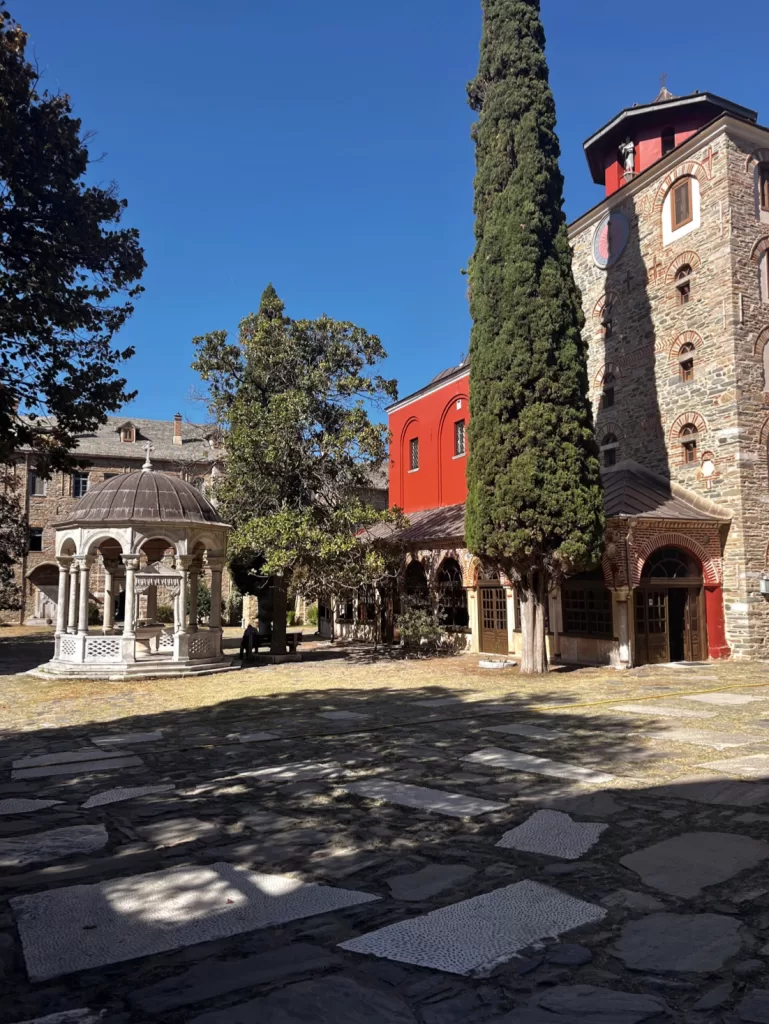
Photos
In my experience, Mount Athos was quite strict when it came to photography. I totally understand Athos isn’t a tourist destination, but when people travel from far reaching corners of the globe, they naturally want to capture some of the special things they’re experiencing.
If you plan to take photos, be expected to stop if explicitly asked to. Otherwise, you will notice many people taking pictures despite the strict rules.
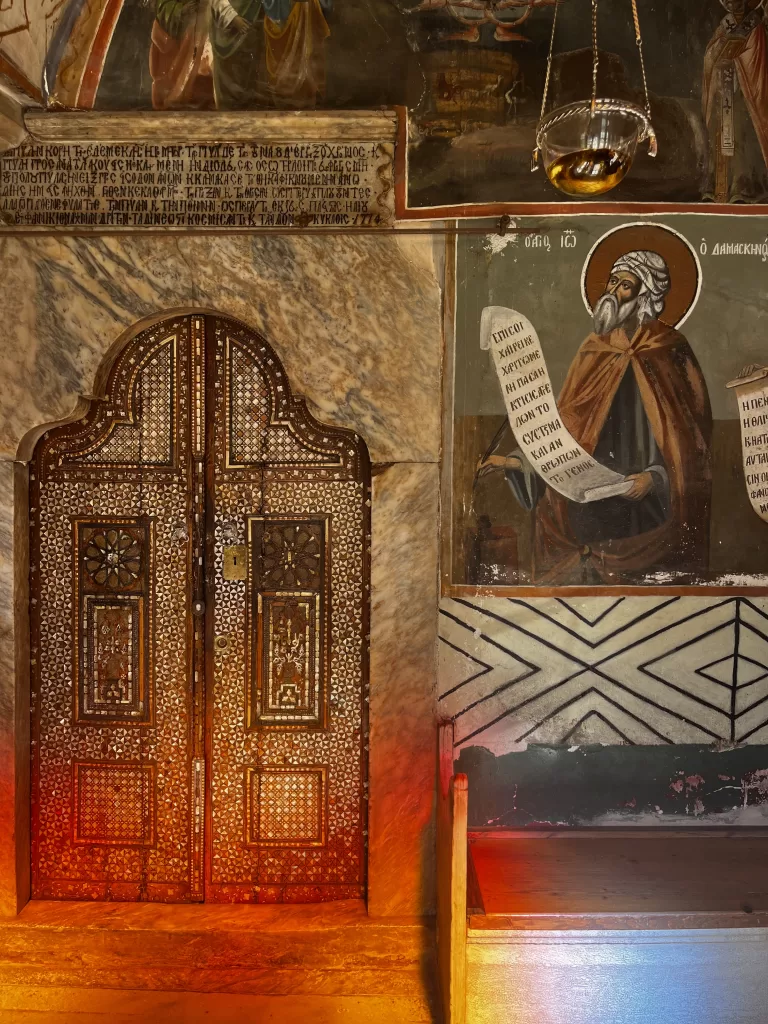
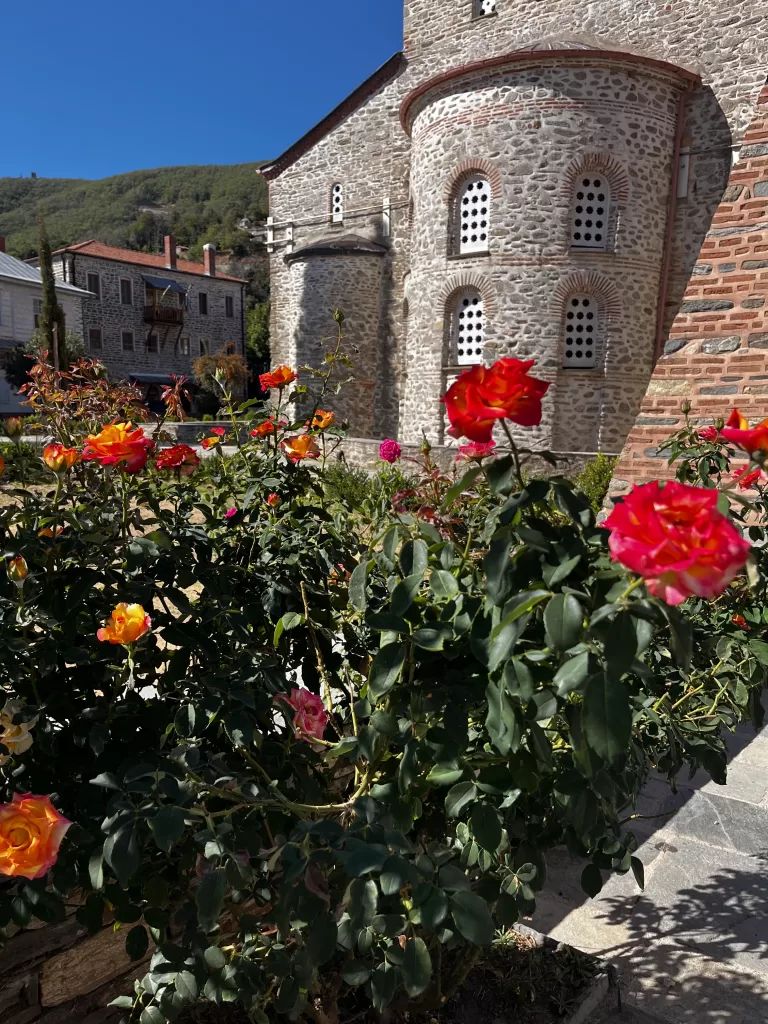
Luggage
I highly recommend bringing luggage that’s easy to move around Athos. I often had to climb steep cobble stone paths and rocky hills with a roller suitcase and leather duffle bag. It wasn’t the most convenient choice of luggage on my journey to the Holy Mountain. It’s best to travel as light as possible when coming here.
Dress Code
Conservative dress is required when traveling to Mount Athos. Long pants should be worn at all times. Shorts are not allowed. Short sleeve shirts are ok, but long sleeves are recommended. Swimming in the sea is prohibited. Closed toed shoes should also be worn when staying in monasteries.
Holy Communion
Only baptized Orthodox Christians can take communion on Mount Athos. Communion rules are stricter on Athos than in the general Greek Orthodox Church. Those wishing to receive Holy Communion should ask the guestmaster or spiritual father of the monastery for permission.
I was unaware of this rule. I didn’t know who the guestmaster or spiritual father was. When I was staying at Iviron Monastery, I was able to receive Holy Communion without any issues. At Dionysiou Monastery, the priest stopped me mid communion line and asked me to step aside. A monk who spoke English told me I had to speak to the guestmaster and wouldn’t be allowed to receive communion. This was a difficult and disappointing moment, especially since I had no issues at the previous monastery.
Karyes | Capital of Mount Athos
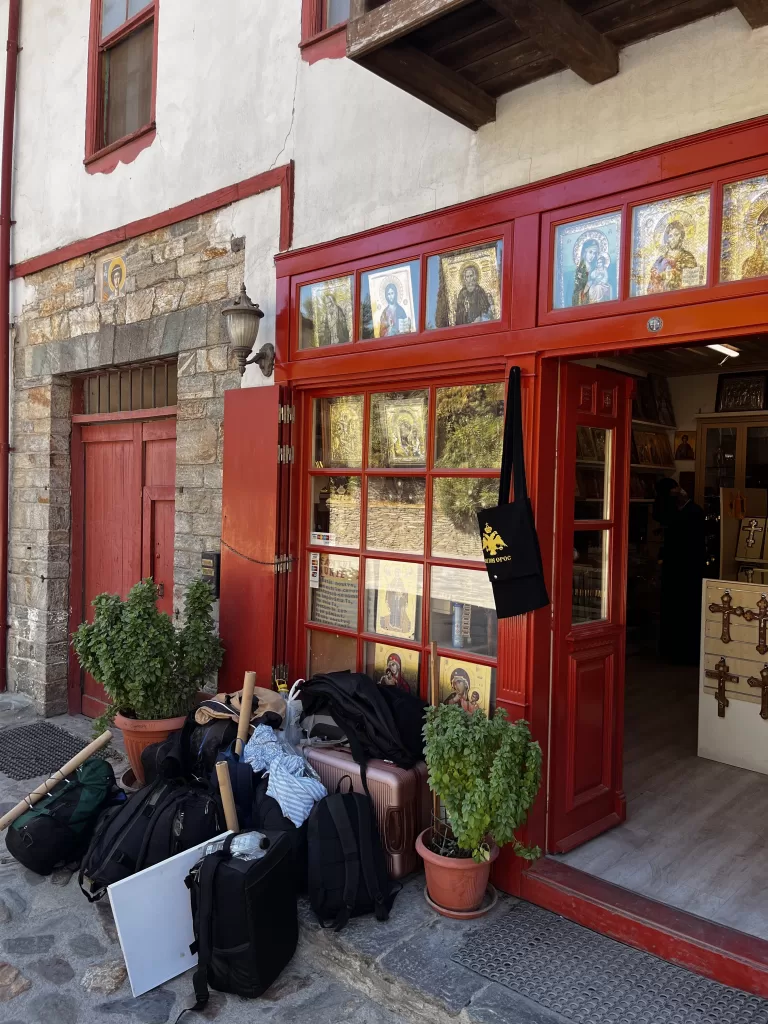
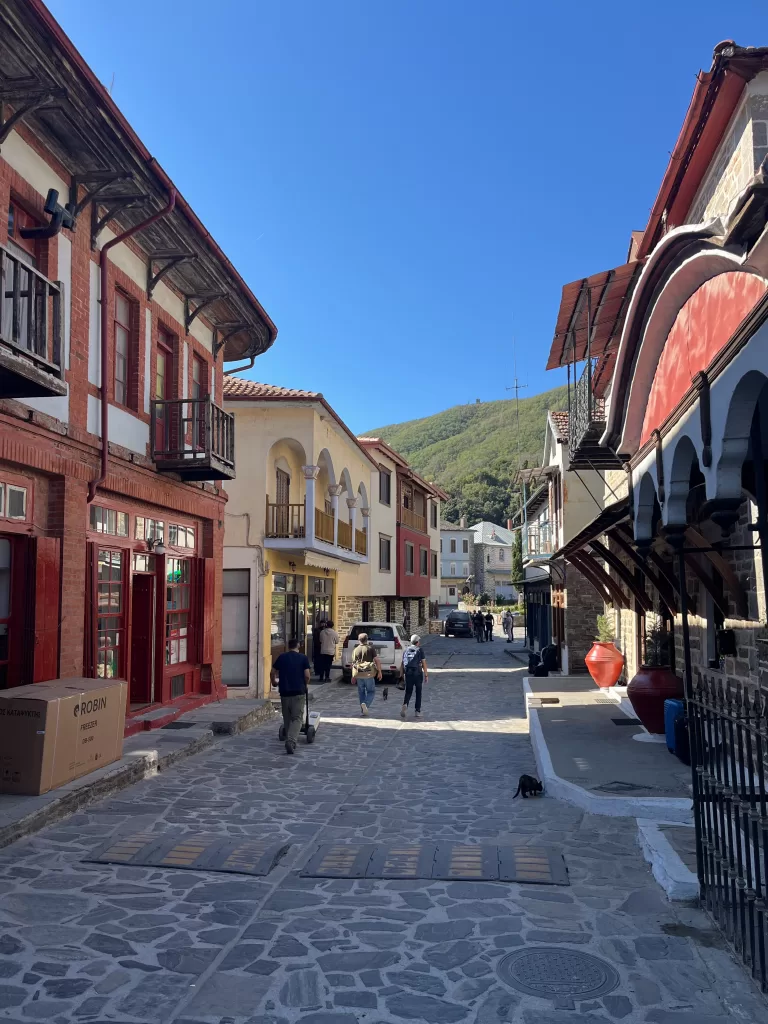
Karyes is the capital of Mount Athos. It’s home to administrative buildings and a few small restaurants and grocery shops. People leave their bags all over the streets as they wait to depart for the next monasteries and stroll around.
Overall, parts of Karyes feel rundown. Some of the buildings are faded and you can sometimes spot street cats fighting in narrow alleyways. There is nothing to do in Karyes except wait for the buses to take you to the monasteries and attend religious services at the Protaton Church. Everything shuts down around 8:00 p.m.
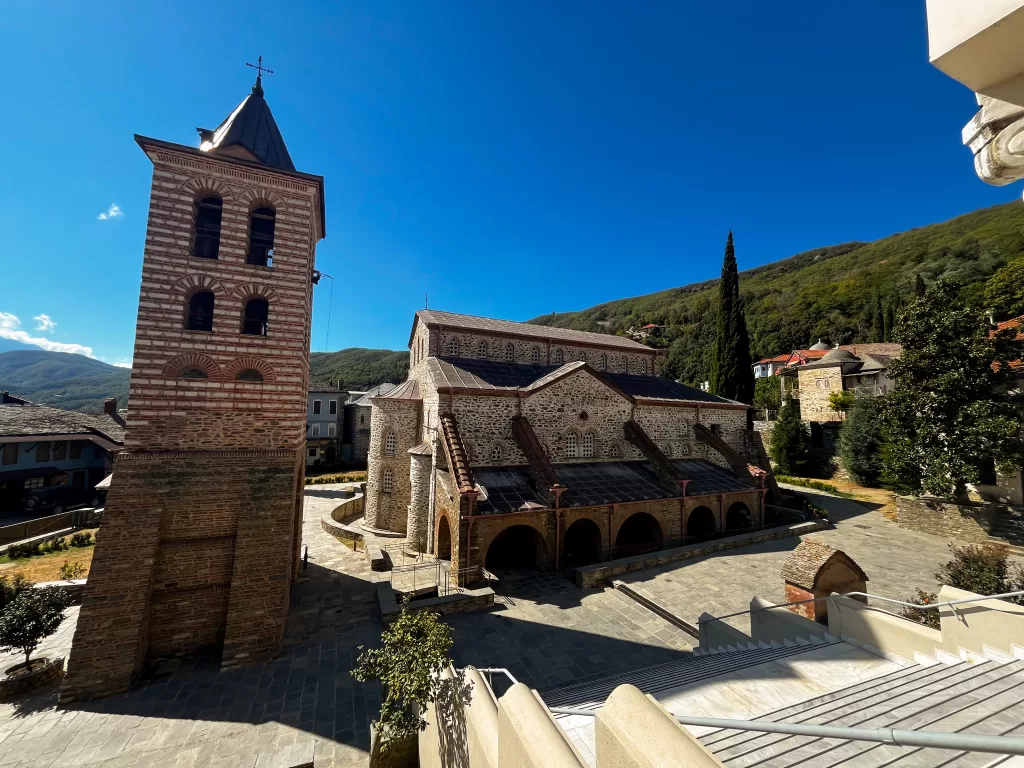
Protaton Church of the Axion Estin
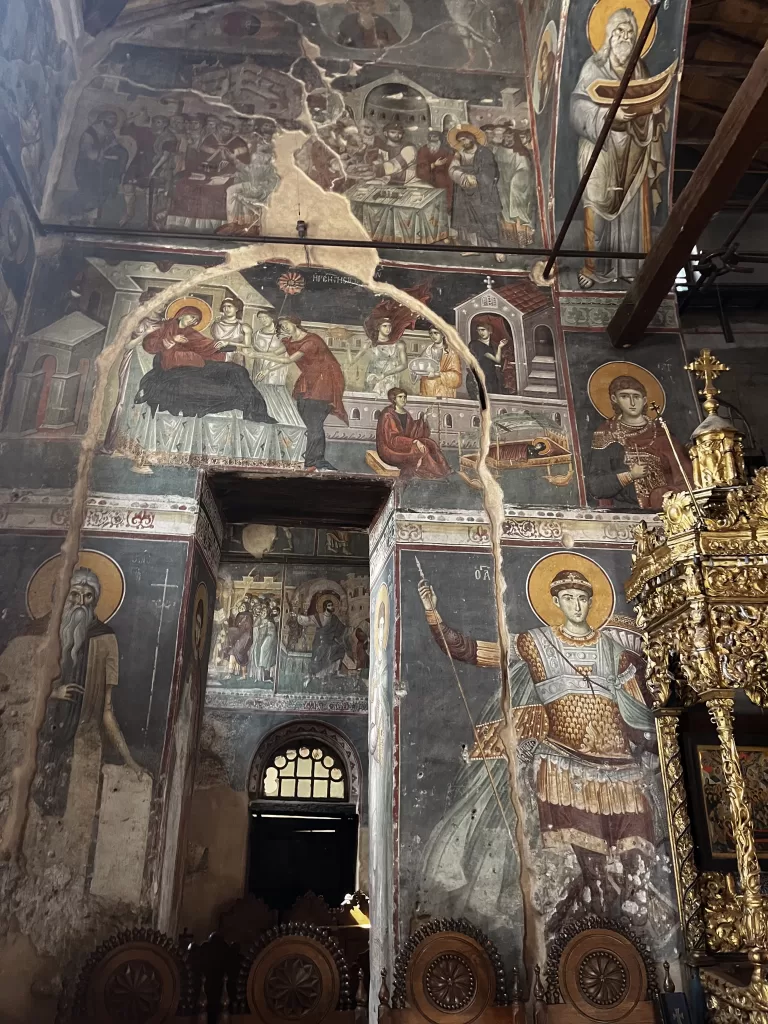
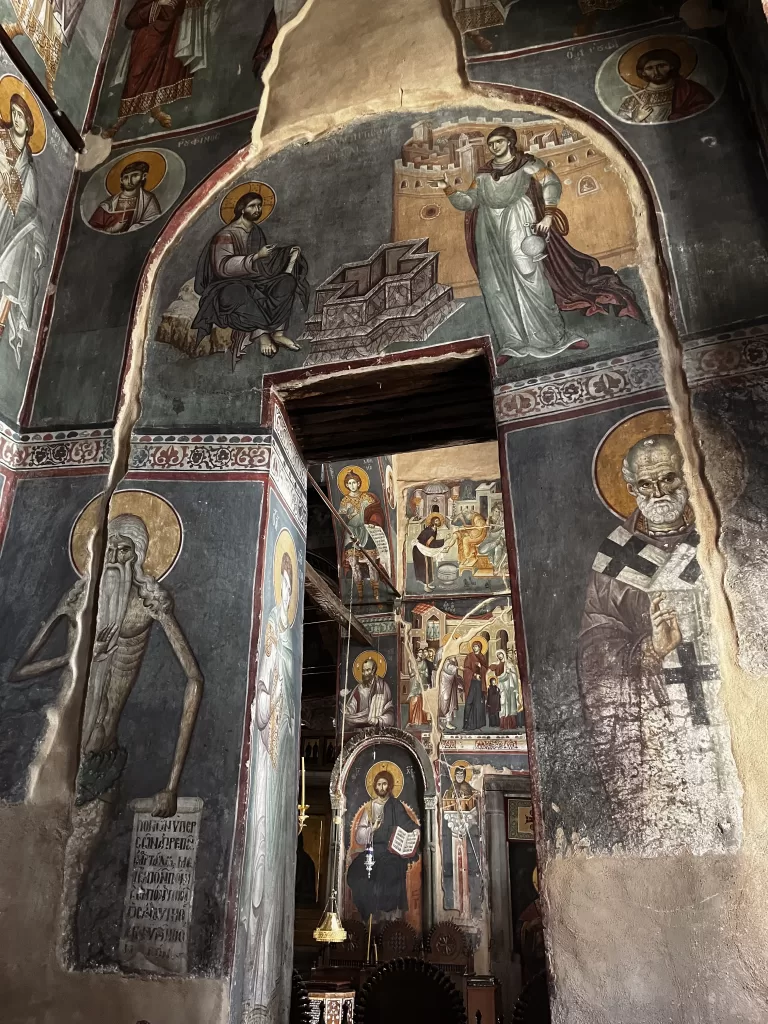
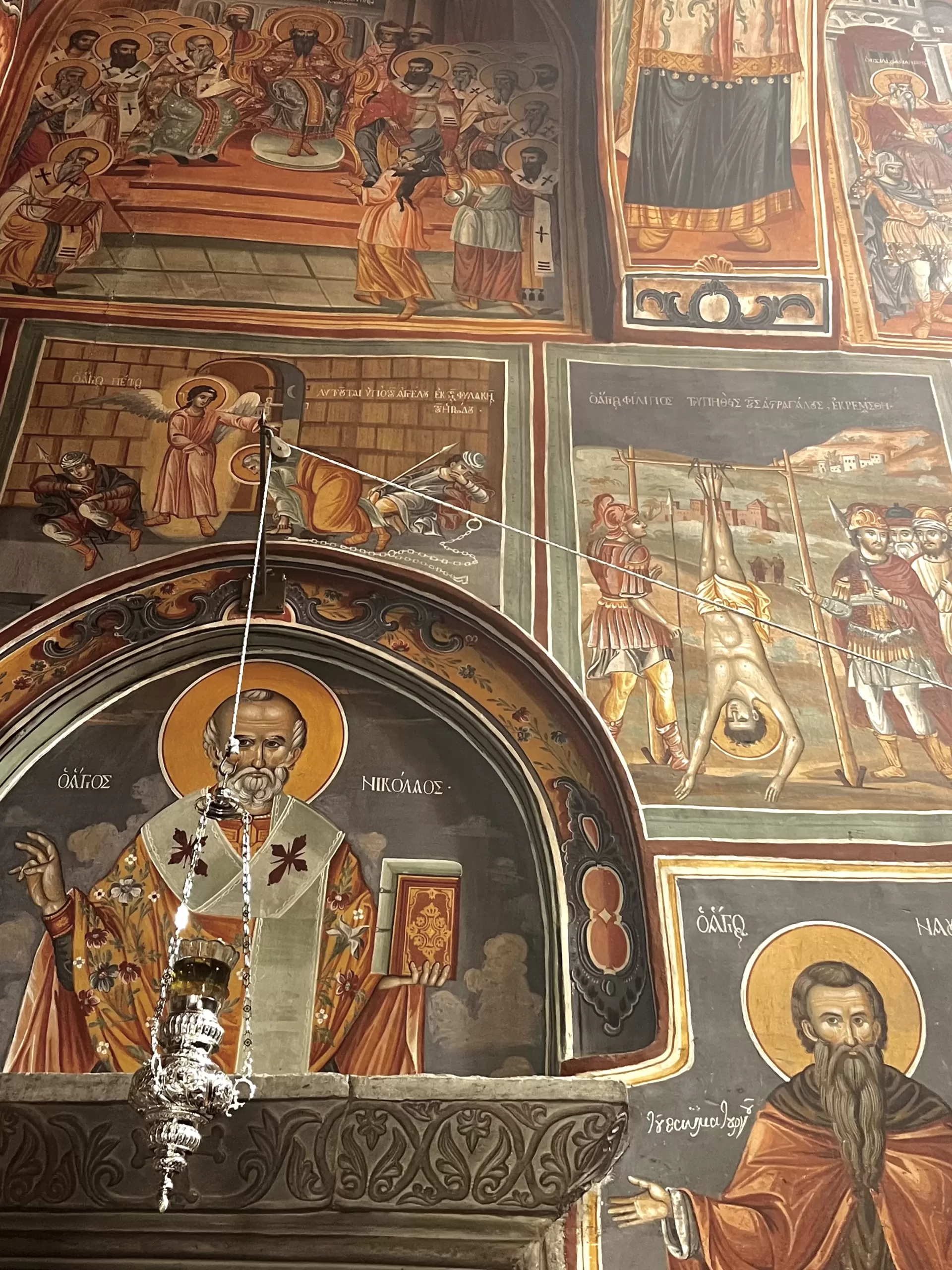
Karyes’ Protaton Church is one of the most significant on all of Mount Athos. The church is built in a basilica style with arches and a vaulted ceiling. Byzantine iconography lines the walls from the floor to the ceiling with images in the life of Jesus and the Virgin Mary. Saints and angels glare down from crevices and on columns. It’s an ancient, mystical space.
Behind the altar lies the treasure of the Protaton Church, the Axion Estin Icon. This is one of the most famous icons on all of the Holy Mountain. It features the Virgin Mary holding the Christ child who is clinging to a scroll. Meaning “she is worthy” in Greek, the Axion Estin Icon is overlaid completely in Silver.
Guesthouses in Karyes
Karyes has a few guesthouses if you wish to stay in the capital during your stay. I spent one night in Karyes and it was honestly enough.
I would suggest staying at the newer guesthouse. There are other older guesthouses above restaurants which are outdated with few accommodations.
// Phone number for the new guesthouse reservation +30 231 601 9591
Monasteries I Visited on Mount Athos
Below are the monasteries I stayed at and visited during my first trip to Mount Athos.
Iviron Monastery
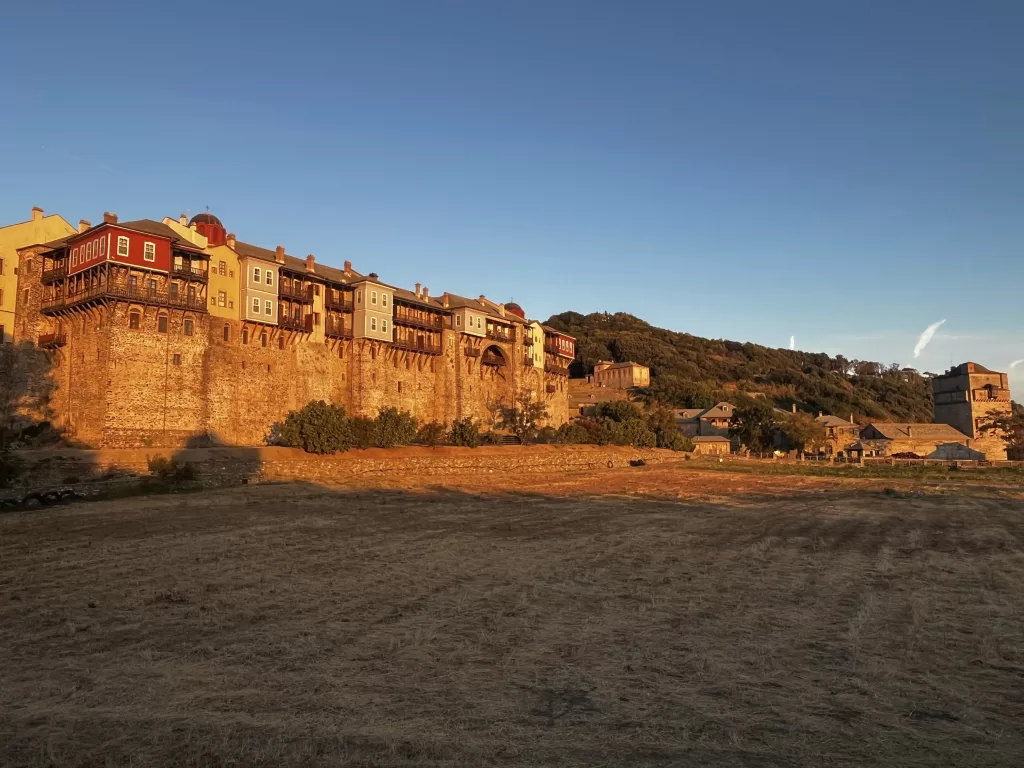
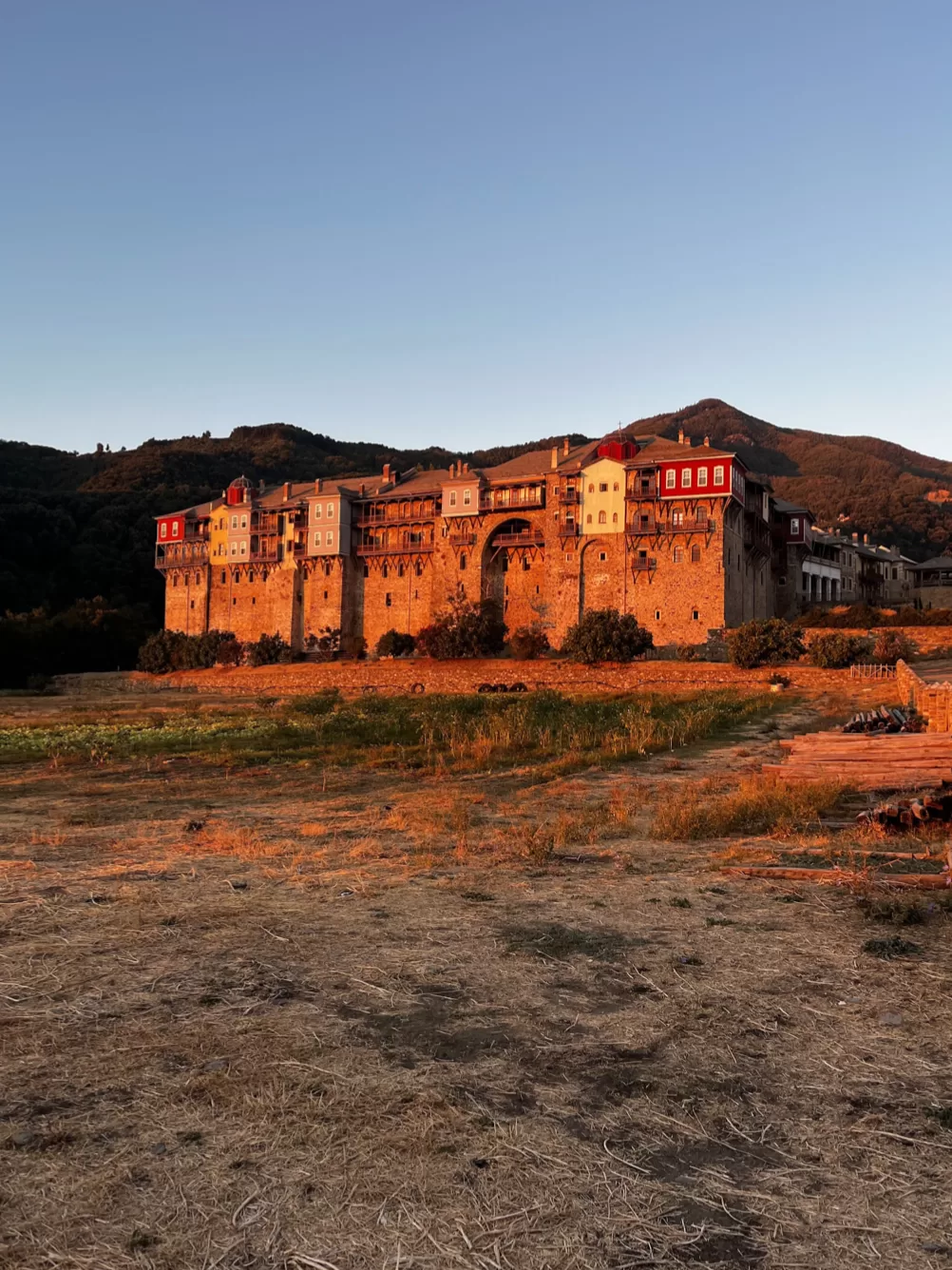
Iviron was the first monastery I stayed at on Mount Athos. Located on the northeast coast of the peninsula, it ranks fourth in importance among the Athonite monasteries. Founded by Georgian monks in 980, Iviron has long maintained a rich scholastic and cultural heritage, especially for the translation of the Bible and other sacred texts into Georgian. In my experience, the atmosphere at Iviron felt more strict compared to other monasteries.
Perched on a steep slope overlooking the Aegean Sea, Iviron offers panoramic views of both the coast and the surrounding forests. It also has its own harbor and shipyard. Surrounded by thick walls built to defend the monastery from invaders, Iviron looks more like a castle than a monastic community. There’s also a tall stone tower which was constructed in 1513 to spot armies and pirates.
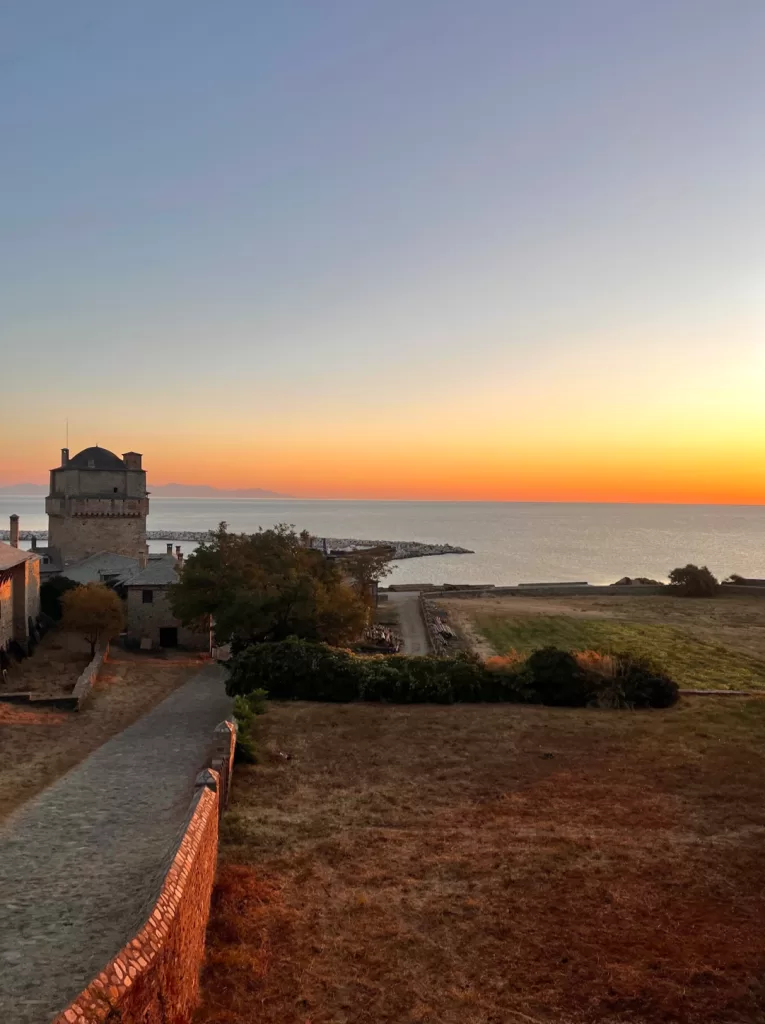
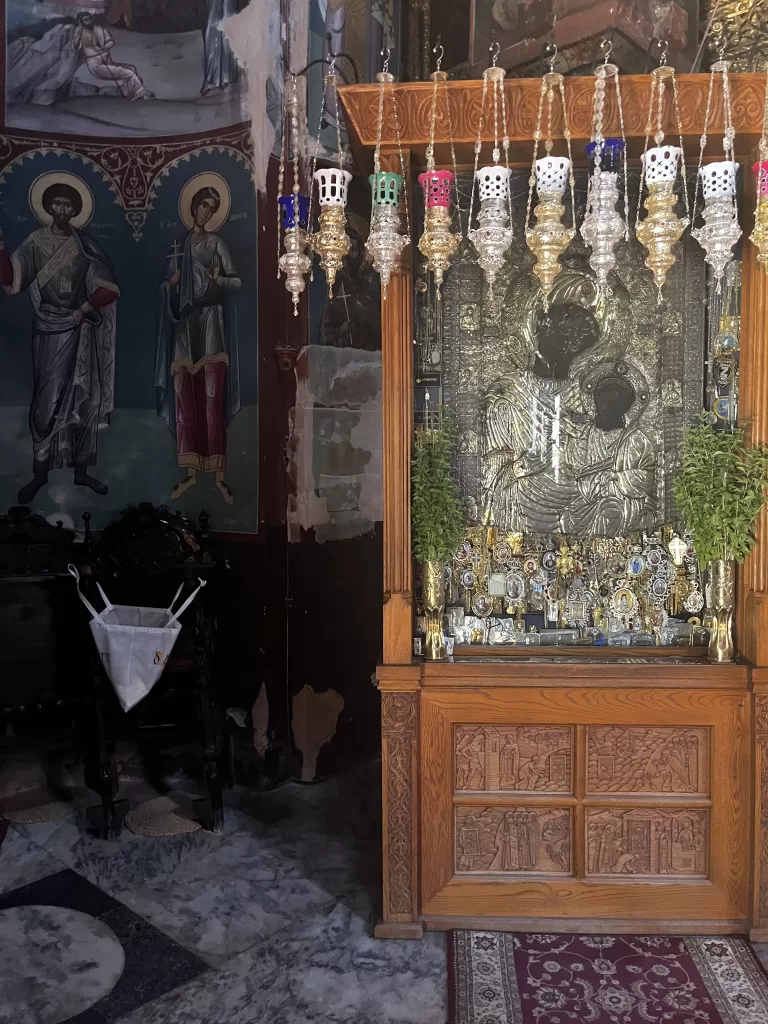
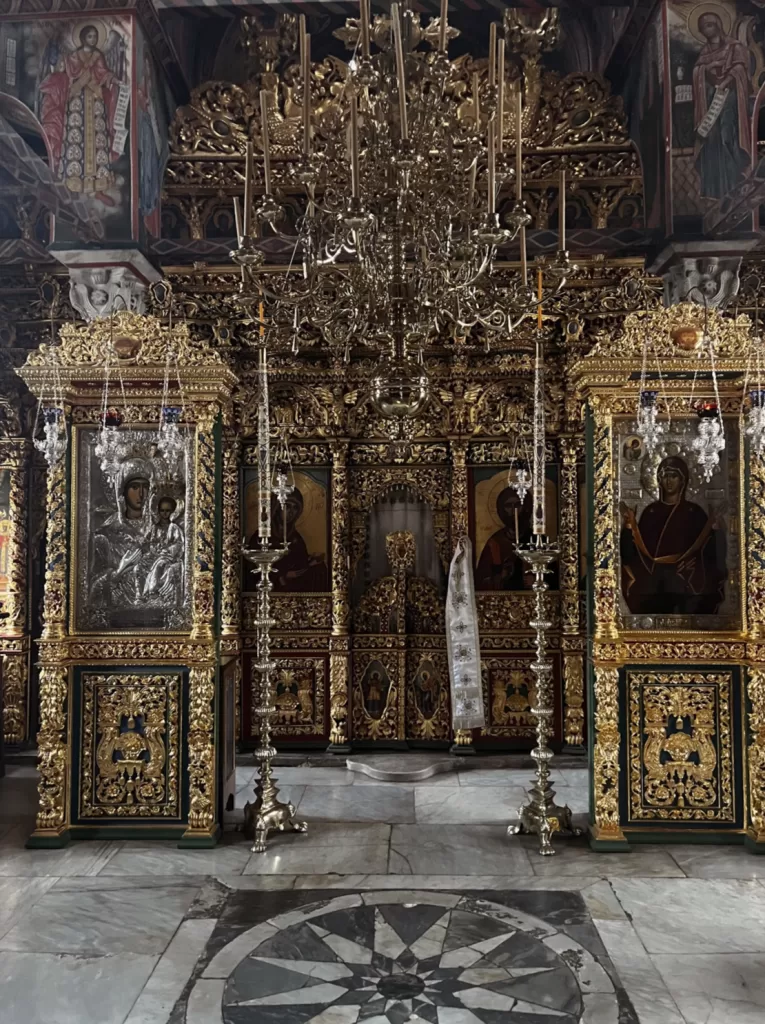
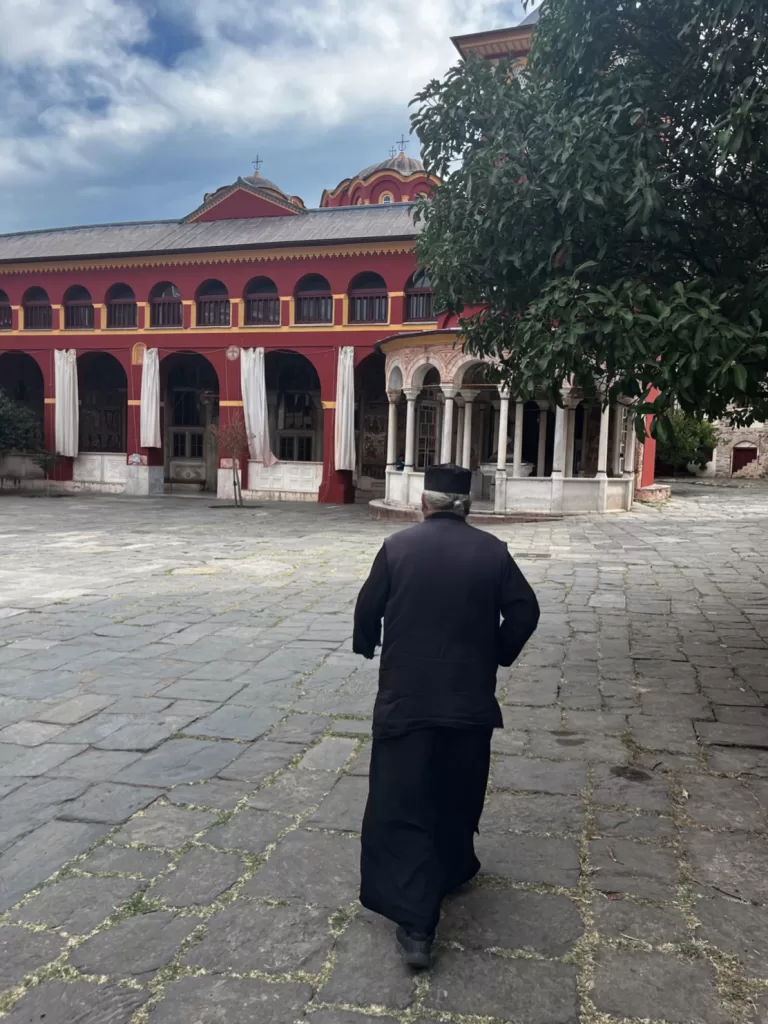
The monastery is organized around a shaded courtyard which is encircled by the monks’ cells. At its heart stands the katholikon (main church) with elaborate Byzantine frescoes stretching from the floor to the ceiling and gilded icons encased in gold and silver adorning the walls. Just adjacent to the katholikon is the side Chapel of the Theotokos Portaitissa that houses a miraculous icon of the Virgin Mary. According to tradition, the icon was first seen floating above the sea in front of the monastery. The Virgin Mary instructed Iviron’s founder, St. Gabriel the Iberian, to walk on water and bring the icon ashore, where it would become a source of devotion for generations of pilgrims.
//Contact information for accommodations at Iviron:
- phone: +30 23770 23643
- email: imiviron@gmail.com
Vatopedi Monastery
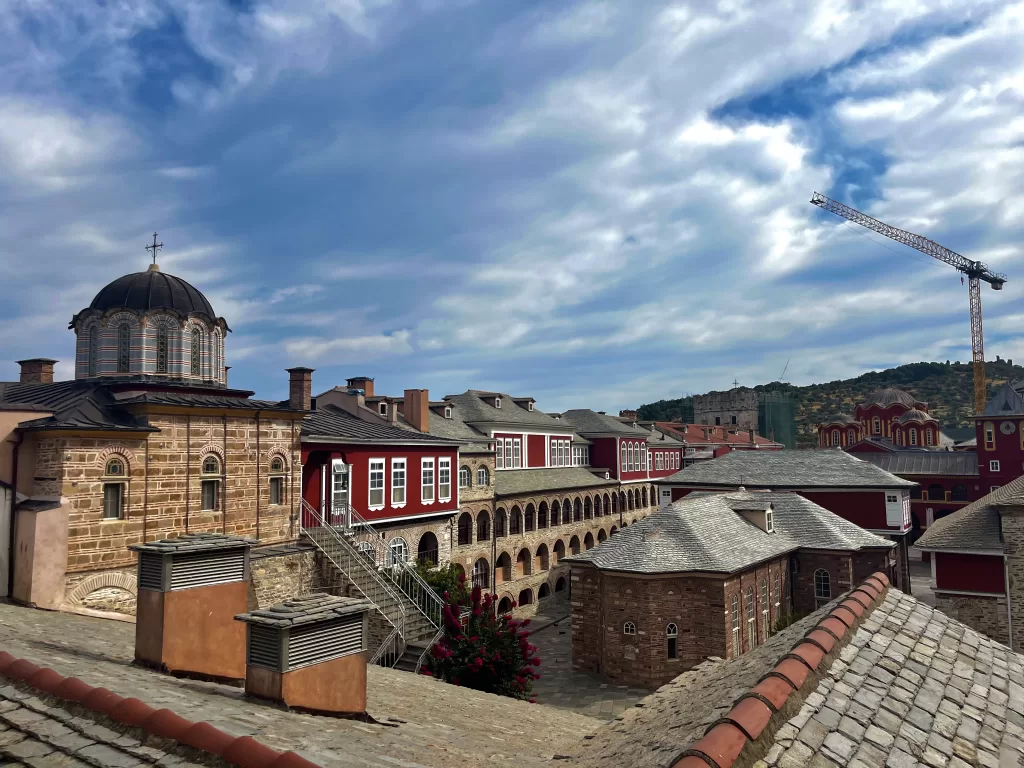
Founded in the 10th century, Vatopedi is one of the most important monasteries on Mount Athos. Dedicated to the Assumption of the Virgin Mary, the monastery is said to house the actual belt of the Theotokos. The sacred relic is credited with many miracles, especially helping women struggling with pregnancy or childbirth. Since women cannot enter Mount Athos, the belt is often brought to mainland Greece for regular blessings.
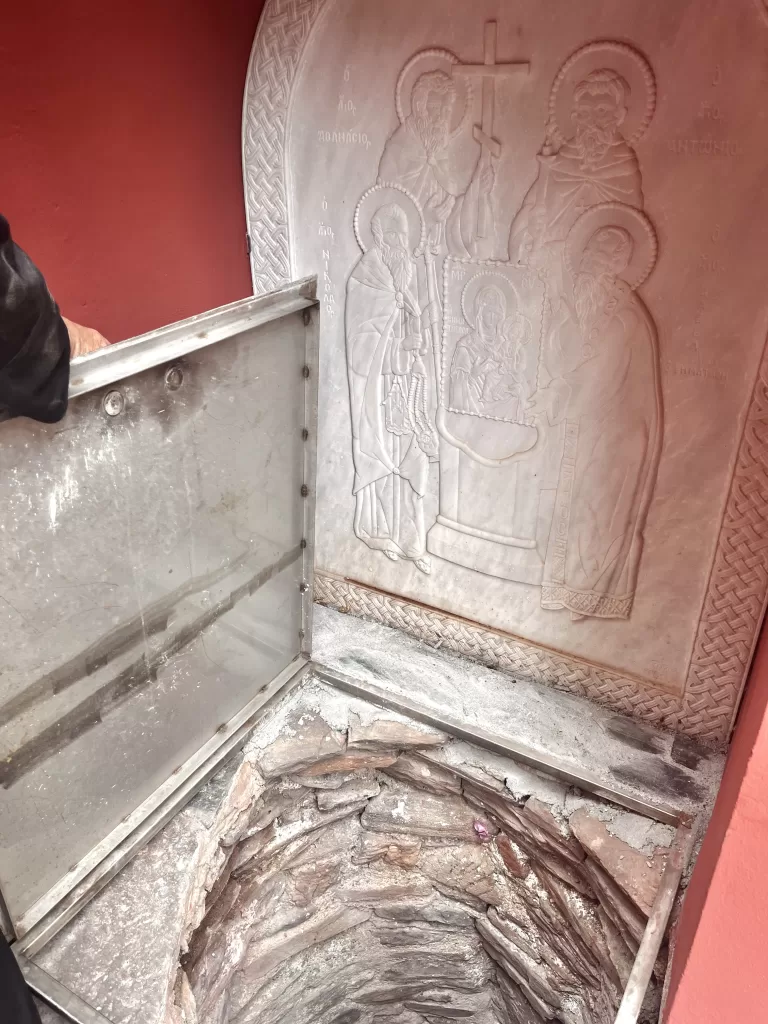
The monastery grounds are expansive. Today, Vatopedi is home to around 60 to 70 monks, though it once housed more than 200 at its peak. Its library and collection of relics, icons, and biblical manuscripts are among the largest and most significant on Athos. Vatopedi contains numerous ornate chapels and even a holy well that descends deep into the earth. The refectory, or dining hall, is also especially beautiful.
//Contact information for accommodations at Vatopedi:
- phone: +30 23770 41488
- email: monastery@vatopedi.gr
Simonopetra Monastery
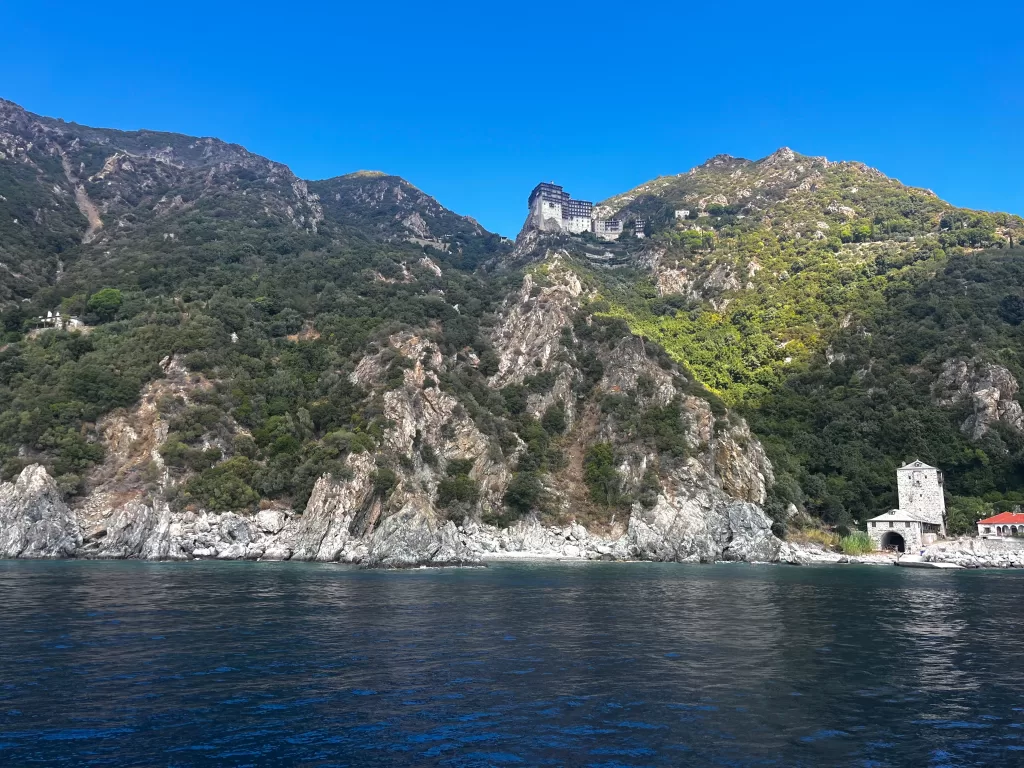
Perched atop a jagged outcrop of bedrock that towers over the endless waters of the Mediterranean Sea, Simonopetra is a breathtaking sight. Translated from Greek as “Simon’s Rock”, Simonopetra was founded by Saint Simon the Athonite after he received a vision from the Virgin Mary instructing him to establish a monastery on the exact spot. She revealed the monastery would serve as the New Bethlehem, and for Saint Simon to dedicate the monastery to the Nativity of Christ. Unlike most monasteries, its feast day and panagiri (celebration) are held on Christmas rather than a Marian holiday or a saint’s feast.
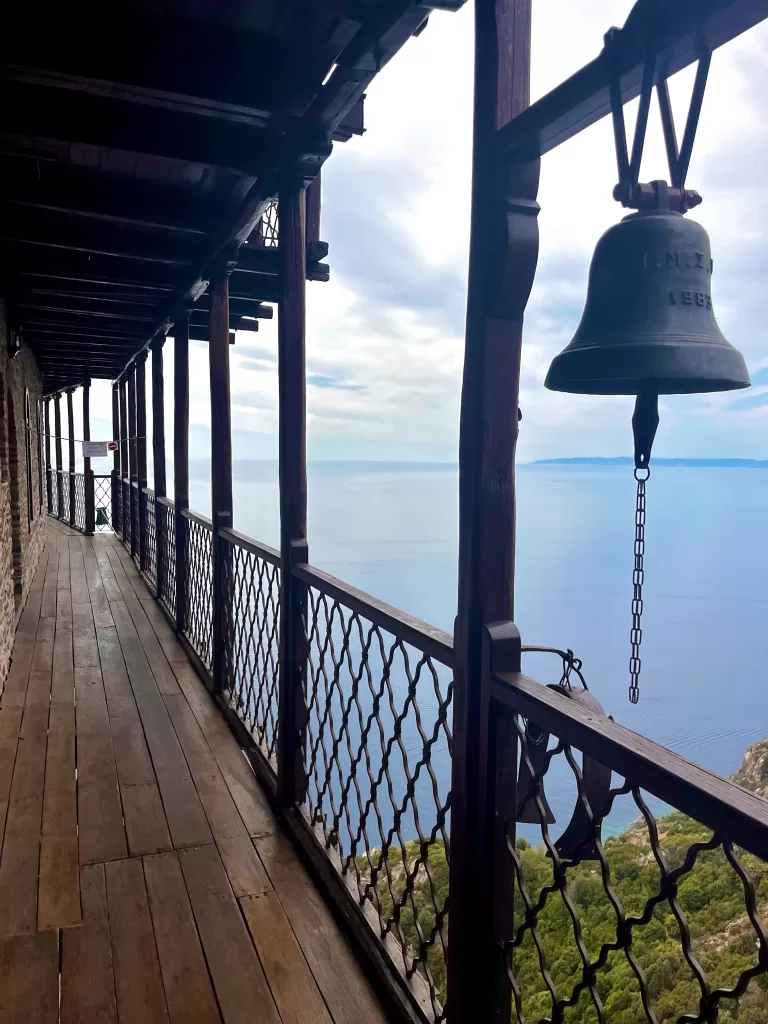
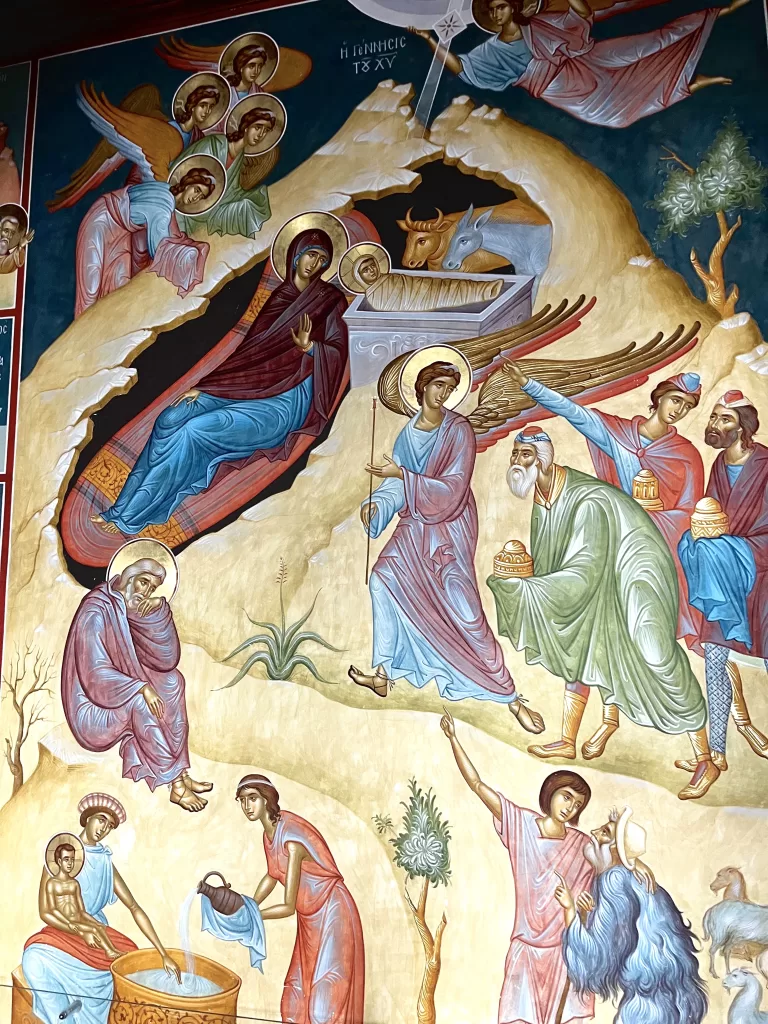
Thanks to its dramatic location and the stunning surroundings, Simonopetra is one of the most idyllic monasteries to explore. Winding through narrow stone corridors of the monks’ quarters feels like an adventure while the large wooden porches with wrought iron railings offer unobstructed views of the Aegean Sea. It’s the perfect place to pause and soak in the scenery. The monastery’s katholikon is especially beautiful and houses a table of relics that includes Agia Anna (mother of the Virgin Mary), Agios Panteleimon the Healer, and a piece of the True Cross of Christ.
//Contact information for accommodations at Simonopetra:
- phone: +30 23770 23254
- email: hospitality@simonopetra.gr
Dionysiou Monastery
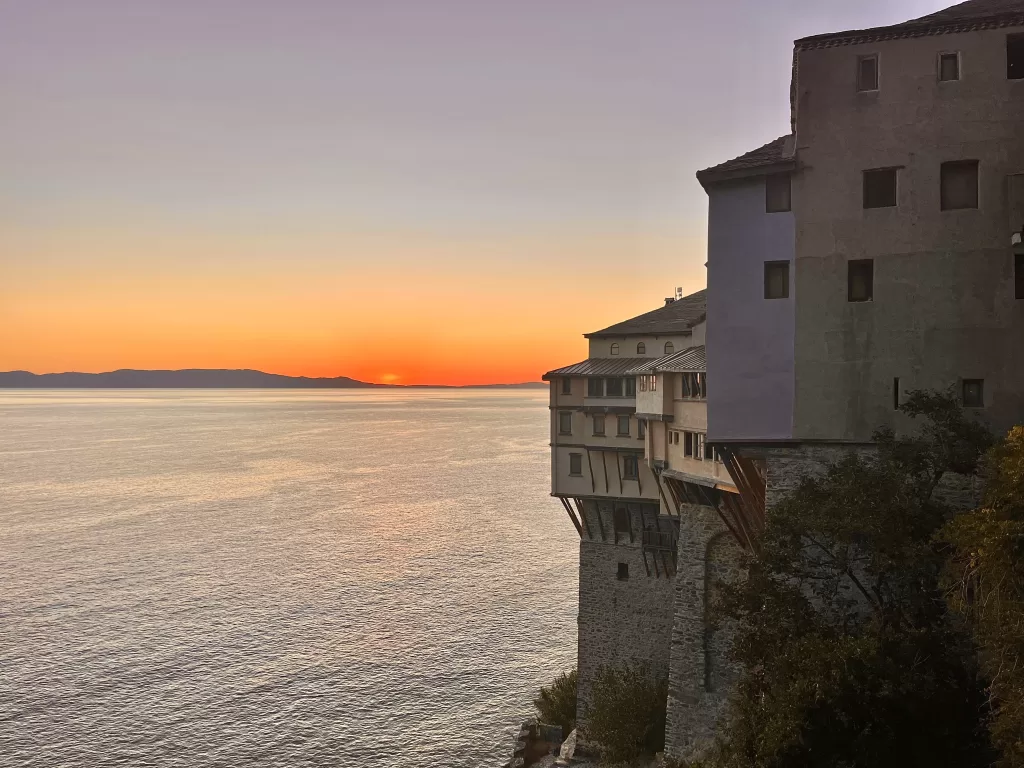
Ranking fifth in hierarchical order of the twenty governing monasteries of Mount Athos, Dionysiou Monastery may just be the most beautiful. This was the last monastery I stayed at, making it a perfect way to end my journey on the Holy Mountain.
Dionysiou Monastery is built on a steep rock that overlooks the Aegean Sea and the island of Euboea across the way. At night, you can see the lights of Euboea, while Athos remains pitch black except for the millions of twinkling stars above. The fortified monastery features some of the most striking architecture on the Holy Mountain. Its large stone bell tower resembles the spire of a castle, while the red katholikon, crowned with multiple domes, is dedicated to Saint John the Baptist. Inside, 16th-century Byzantine frescos and precious icons framed in gold adorn the walls. After evening services, a table is set with countless relics from across the Orthodox world for pilgrims to venerate. Meals in the refectory are simple yet incredibly nourishing.
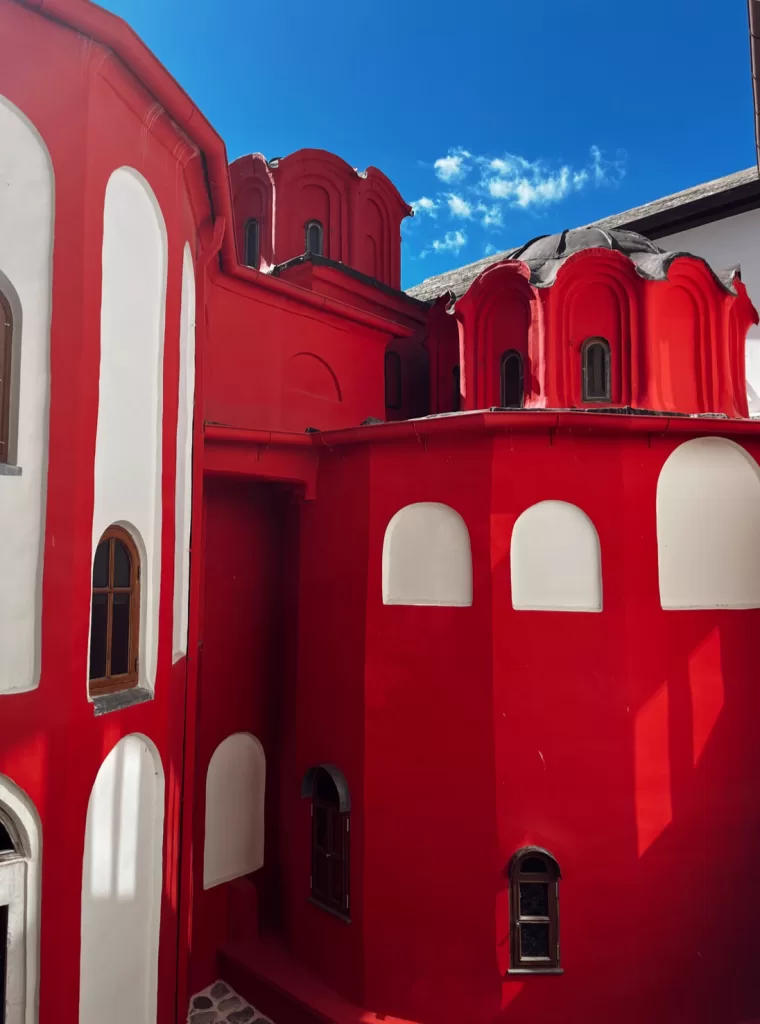
Chapel of the Akathistos
Adjacent to the katholikon is a chapel housing a famous icon called Akathistos, or the Virgin Mary of the Akathist Hymn. According to Orthodox tradition, during an attack on Constantinople, the city’s residents held the icon over the walls and saw the Virgin Mary appear in white with her arms outstretched protecting the city. To this day, the monks of Mount Athos believe the icon has shielded Dionysiou Monastery from invasion on multiple occasions. It is also said to be one of three icons painted by St. Luke the Evangelist and is known to stream myrrh from time to time. The exterior of the church features intense imagery inspired by the Book of Revelation and the end times.
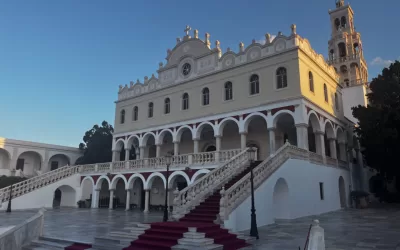
// During a conversation with an English speaking monk named Father Eugene, I mentioned my visit to Tinos and the Panagia Evangelistria Church before coming to Mount Athos. He noted that people sometimes dub the island of Tinos “a little Athos”. My pilgrimage to the Panagia Church on Tinos felt like a natural complement to my journey to the Holy Mountain.
//Here is my guide to visiting the Panagia Church on Tinos; the most visited church in Greece
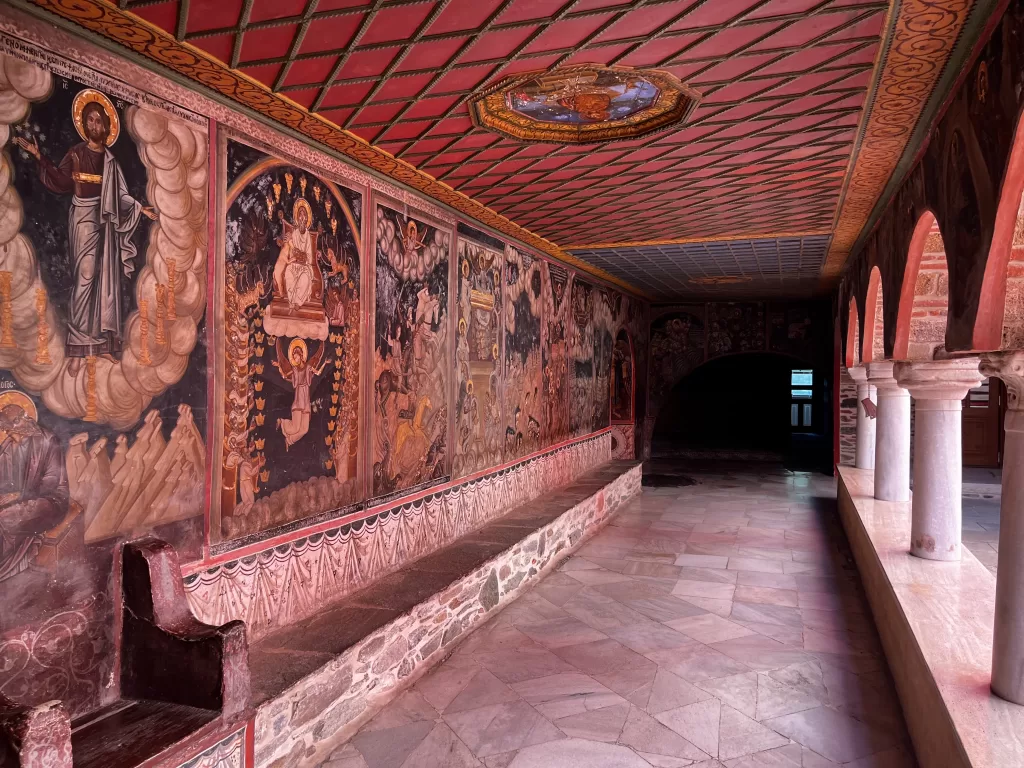
Because Dionysiou Monastery is quite large and has many cells, it’s easier to acquire a private room. One of the highlights of staying here is exploring the hiking trails and mountain paths that wind around the monastery, leading to some of the most scenic areas across the peninsula.
//Contact information for accommodations at Dionysiou:
- phone: +30 23770 23687
- email: monidionysiou@gmail.com
4 Day Mount Athos guide Itinerary
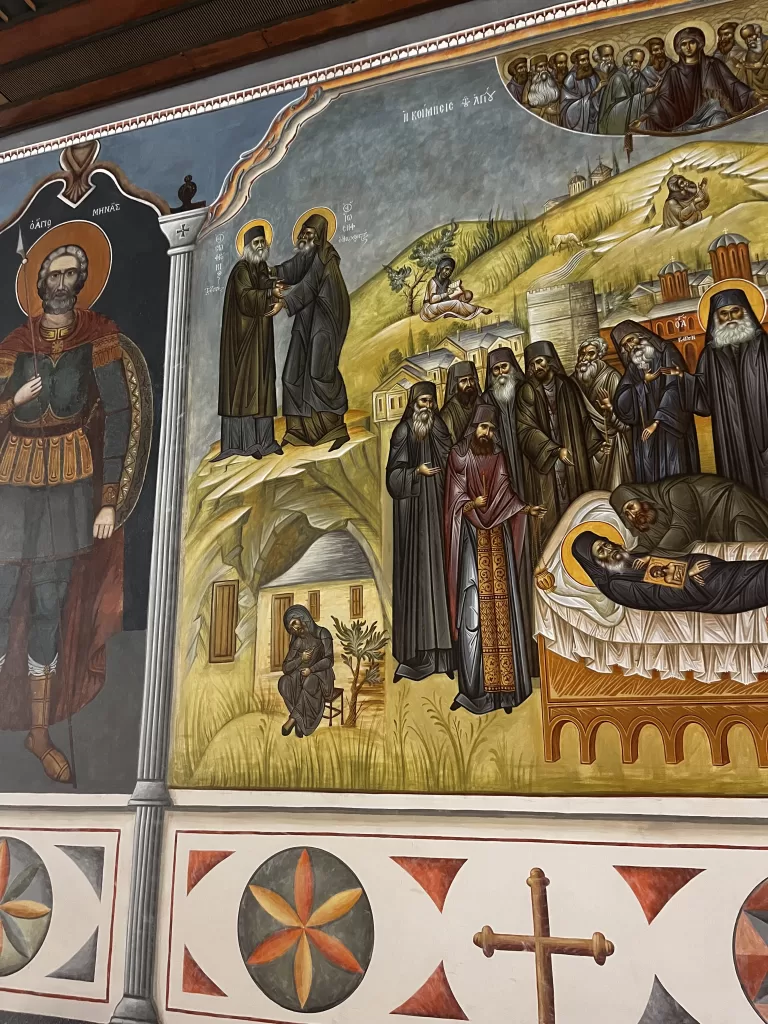
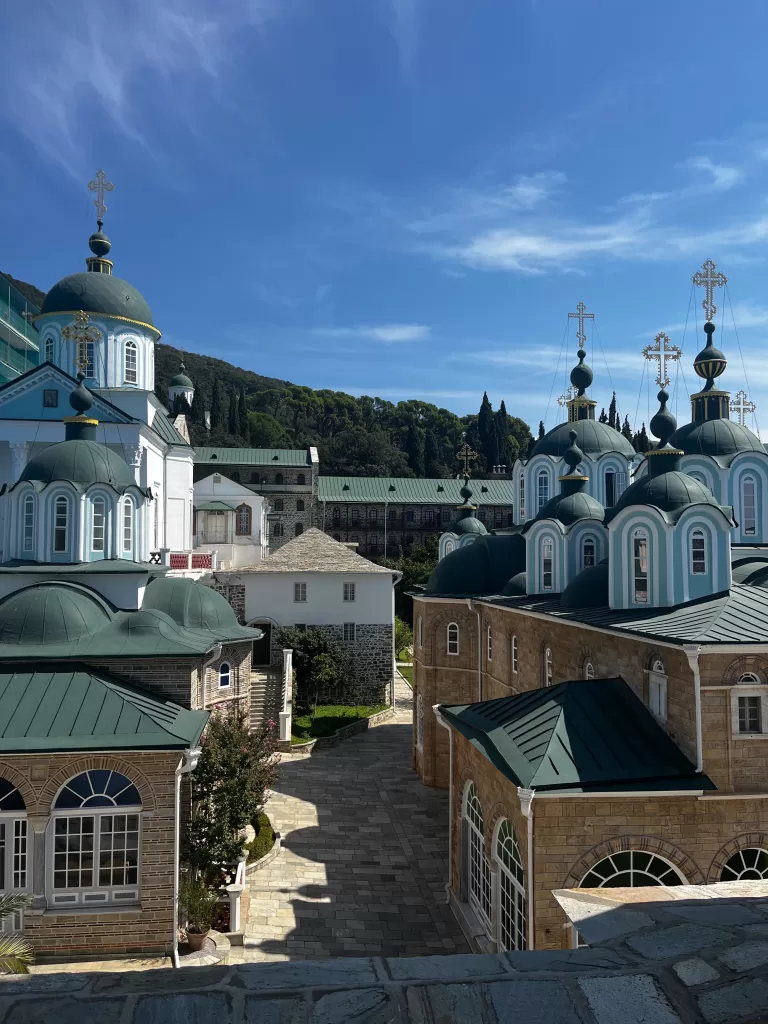
Here’s a snapshot of my four days exploring Mount Athos.
Note: Remember that your exact itinerary may differ based on which monasteries you choose to stay at and how early and how late you depart the Holy Mountain. Consider this as an example on how to plan your own schedule on Athos.
Day 1 on Mount Athos guide
- Depart Ouranoupoli at 8:30 a.m. and arrive at Mount Athos at the port of Daphni
- Take mini bus from Daphni to the capital of Karyes
- Two hour wait in Karyes to enjoy a freddo espresso and visit Protaton Church
- Bus from Karyes to Iviron Monastery
- Explore the grounds of Iviron and venerate Panagia Portaitissa icon
- Walk the shoreline and surrounding forests near Iviron
- Vespers services and dinner in the refectory
- Overnight stay at Iviron monastery
Day 2 on Mount Athos Guide
- Attend religious services at 3:00 a.m. to 7:00 a.m.
- Quick breakfast of whole grain bread and olives
- Driving tour of Mount Athos with Fr. Nick
- Visit Vatopedi Monastery, Agios Panteleimon, and Simonopetra Monasteries
- Venerate the belt of the Virgin Mary
- Lunch and nap at Karyes; check into guesthouse
- Evening services at Protaton Church and venerate Axion Estin icon
Day 3 on Mount Athos Guide
- Morning Orthros at Protaton Church
- Bus from Karyes to port of Daphni
- Speed boat from Daphni to Dionysiou Monastery
- Uphill walk from harbor to monastery entrance
- Explore grounds of Dionysiou and paths around the monastery
- Venerate Akathist Icon
- Attend Vespers at Dionysiou Monastery
Day 4 on Mount Athos Guide
- Religious services begin at 3:00 a.m.
- Break at 5:30 a.m.
- Paraklisis and Divine Liturgy at 7:00 a.m.
- Speed boat from harbor at Dionysiou to port of Daphni
- Ferry from Daphni to Ouranoupoli, depart Athos
Other Greece Blogs and Guides
I hope you found my Mount Athos Guide helpful as you prepare for your journey to Greece’s Holy Mountain. If you have any questions or thoughts, feel free to leave a comment below. I’d love to hear about your experience visiting Athos. Happy travels!
Here are some of my other Greece blogs and guides for inspiration for your upcoming trip:
- Church of the Panagia Evangelistria (Greece’s most visited church)
- Tinos Island Guide
- Karpathos Island Guide
- Chania Town Guide
- Crete’s Akrotiri Peninsula
- Orthodox Easter on Crete (COMING SOON)
- Crete Island Guide | Exploring Greece’s biggest island (COMING SOON)
- The Mani Peninsula | a Hidden Gem on the Greek Mainland (COMING SOON)
0 Comments